On the Franco-British border: plus ça change, plus c'est la même chose?

On 27 November 2021, twenty-seven lives were abandoned to the English Channel by the French and British states, as fifteen calls in distress went unanswered. A year later, Le Monde exposed the exchanges between those on board the small boat and the regional maritime rescue and surveillance centre in the Pas-de-Calais, exchanges which the French state initially denied had taken place. ‘Tu seras pas sauvé…  je t’ai pas demandé de partir’, rang the voice of one operator to the call of distress at sea: ‘You will not be saved… I did not ask you to leave [France]’.

This loss of life at sea, while the worst incident in thirty years in the Channel, in fact fits within a historical continuity of the last twenty years of violent and reactive Franco-British border politics. In this history, the agency of those who have decided to make this perilous journey is deeply constrained: what does choice look like when there is simply ‘no other option’?

Holocaust refugees in a global context

There has been a recent global turn within Holocaust Studies: a growing body of scholarship focuses on Jewish refugees and the Holocaust in contexts that had been previously ignored, and highlights how those experiencing the war in Europe did so in different ways to those living through the conflict in other parts of the world. This post focuses on Jewish refugees who travelled to Japan, and who in the process often made journeys covering multiple countries across land and sea. For example, many Jews who arrived in Kobe, a city in Japan, in the early 1940s arrived via Poland, Lithuania, and the Soviet Union, having used the Trans-Siberian railway and sea travel to cross multiple borders.

Refugees and neutral territories: Hong Kong and Macau during World War II

Studies of neutrality tend to focus on legal and diplomatic aspects, but there is also an important social dimension: neutral territories are often destinations or stopovers for refugees, especially when these territories are adjacent to conflict zones. What does neutrality mean in practice when we put refugees at the centre of analysis? British-ruled Hong Kong and Portuguese-ruled Macau in the 1930s and 1940s offer connected case studies of displaced persons during the Second World War in East Asia.

Digital research on twentieth-century refugees: dealing with information overload

Digital technology has transformed archival research. Instead of painstakingly taking notes most historians today take digital pictures or scans from archival documents. The advantages are undeniable: it reduces time spent in one archive, which increases the possibility to visit more archives and enhances accuracy. However, there are downsides, too. Access can lead to excess. The sheer volume of paper has exponentially increased since the invention of the typewrite in the late nineteenth century; computers, digitisation, and online access have only enhanced this growth. Hence, historians often end up with enormous collections of research photos on their personal devices. Many struggle to properly process their digital material. The problem of multitude is no longer situated during but after the archival visit.

Refugee connections – autumn semester roundtable

We are delighted to announce the speakers for the ‘Doing refugee history’ autumn semester roundtable, focusing on refugee connections. Attendance is open to anyone, but registration is required. A sign-up link is included below.

Speakers at this session are:

  • Stephanie DeGooyer (University of North Carolina at Chapel Hill)
    The connection between early American refugee history and Native dispossession

  • Edidiong Ekefre (University of the Witwatersrand)
    Fleeing Boko Haram: historicizing the refugee connections in the Lake Chad basin, 2010-2020

  • Neela Hassan (University of Waterloo)
    A site of connection for refugees: forming community based on shared vulnerability and precariousness at an Afghan restaurant

  • Ryan Sun (University of British Columbia)
    The possibilities in transit: Jewish refugees onboard Shanghai-bound ships (1937-1940)

Collective poetry and refugee history

What can a poem, and the creative process of writing it, tell us about refugee history? Existing research on creative writing by refugees tends to focus either on the writing process or the writing itself. Research on the writing process is usually situated within the social sciences and examines the effect of this process on language acquisition, confidence building or wellbeing. Refugee literature is a field in itself, one that looks at the texts first and foremost, and even then mainly texts produced by published writers. Creative methods including collective poetry are a way of combining both of these approaches, allowing us to experience, document and analyse both the process and the output.

The unwilling nomads of twentieth-century Europe

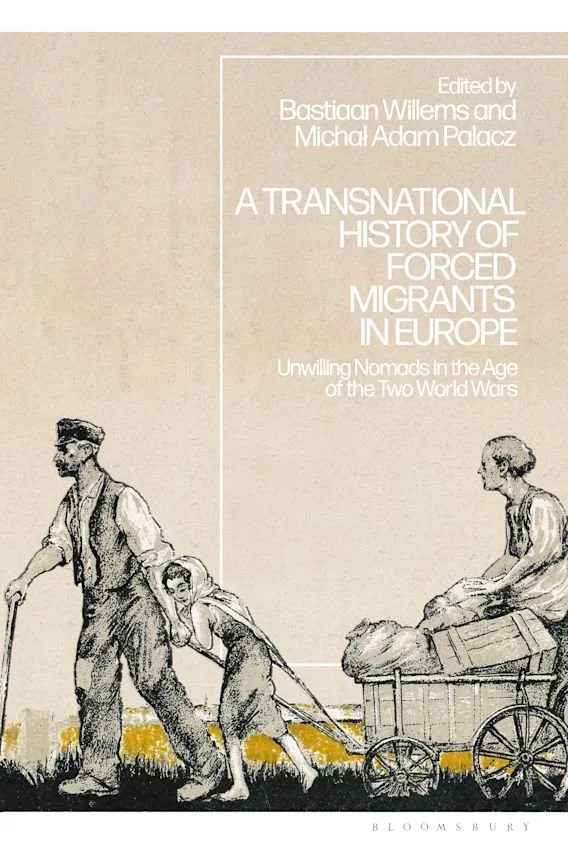
In the first half of the twentieth century millions of Europeans were displaced by war, genocide, the redrawing of international borders, and mass flight from countries ruled by autocratic regimes. In order to address the need for a more integrated analysis of their experiences, our edited volume A Transnational History of Forced Migrants in Europe. Unwilling Nomads in the Age of the Two World Wars looks at the collective experience of different refugee groups through the lens of a four-dimensional model of ‘host society’, ‘homeland’, ‘diaspora’ and ‘other diasporas’.

‘On the case’: methodological and ethical challenges of using casefiles as sources for refugee history

Casefiles are a common source for scholars in social history and related fields. They have, for instance, been crucial in the development of micro-historical approaches to the Holocaust. In recent years, they have been taken into consideration to examine humanitarian responses to and experiences of forced displacement. In this post, I would like briefly to discuss some of the potential, limitations, and challenges that this material entails. To do so, I will examine a specific set of sources: the casefiles of a group of more than 1,000 young Holocaust survivors who were resettled to Canada in the aftermath of the Second World War through a project sponsored by the Canadian Jewish Congress (CJC). These young people were predominantly Eastern European teenage boys who, at the time of application for a visa, lived in Displaced Persons (DP) camps, children’s homes and with foster families across Europe.

Who is counting the refugees? Displacement data, its limitations, and potential for misuse

It is impossible to think about refugees, write about refugees, advocate on behalf of refugees or provide refugees with practical support without the use of statistics. And yet scholars and practitioners working on the refugee issue were surprisingly slow to examine the complexities associated with the collection, analysis and dissemination of quantitative data. As I pointed out in a paper published in 1999, “while all of the standard works on refugees are replete with numbers, few even begin to question the source or accuracy of those statistics.” The issue of refugee and displacement statistics is now taken a great deal more seriously than was the case two decades ago. Even so, the issue of displacement data remains problematic.

Refugee connections – call for papers

We are pleased to announce that the ‘Doing Refugee History’ series will continue this year with two roundtables. The first will explore the subject of refugee connections and will take place on Thursday 20 October 2022, 2-4pm UK time.

As displaced people, refugees are often assumed to be disconnected—to have lost their connections to the places, people, and things that matter to them. Humanitarian programming in first countries of refuge, and refugee integration strategies in resettlement countries, aim to create new economic and social connections for refugees. But what connections have refugees, over time, made for themselves?