

Christian anti-communism and the history of refugee relief
[Reproduced with permission of the American Catholic History Research Center and University Archives]
We’re all familiar with the fact that refugees are treated differently depending on what exactly they are fleeing from. During the 20th century, the refugees who often received the most international support and the most favourable treatment were victims of communism. Indeed, those fleeing communist oppression were central to the construction of the modern international refugee system.
Much of that system emerged at the end of the Second World War. The global refugee crisis caused by the war and its aftermath was met with a rapid expansion of private NGOs and the emergence of new international laws and institutions. One of the understudied forces behind this this process was Christian anti-communism. The history of post-war refugee relief is often presented as part of the triumph of modern ideas about human rights and the spread of humanitarian values, but a closer examination of some of the main organisations and actors paints a different picture.
Christian NGOs from Europe and the United States delivered the bulk of private refugee relief in the mid-20th century. These included both Catholic organisations like Caritas and the National Catholic Welfare Conference (NCWC), and Protestant ones like Evangelische Hilfswerke and Christian Aid. In its early years, UNHCR didn’t run relief programmes directly but spent its funds through grants to private relief organisations, particularly Christian NGOs. Indeed, much of UNHCR’s early funding came from the Ford Foundation in a donation which was organised by Christian NGOs like the NCWC and the World Lutheran Federation, and then largely channelled through their own relief projects, for example supporting refugee children in Germany and Austria.
The work of these NGOs in the decade and a half following the end of the war focussed on very specific groups of refugees: Christians fleeing communism. These included the German “expellees” and “escapees” escaping Soviet-dominated Eastern Europe, Vietnamese Catholics moving from North to South following the first Indochina war and the partition of the country in 1954, Hungarians moving to the West following the defeat of the uprising in 1956, and Cubans seeking to leave the country after Castro’s seizure of power in 1959.
Christian NGOs valued these refugees not only on account of their needs and suffering, but also for the power of their stories. At a time when humanitarian organisations were developing innovative new publicity and communication techniques, they filled their campaigning materials with stories designed to encourage Western publics to link refugees to the Christian struggle against communism. In magazines, teachers’ handbooks, posters, and newspaper articles, Christian refugees were presented as innocent victims, as heroic freedom fighters, or as hard-working future citizens of the West.
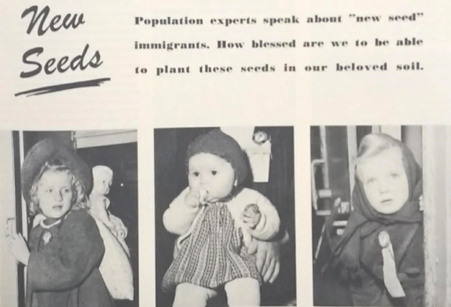
Image courtesy of American Catholic History Research Center and University Archives
Most of these stories involved children. Stories about children written for children were designed to hammer home the stakes involved in the Cold War - if this could happen to good Christian children abroad, they implied, it could also happen to you and your friends if the fight against communism is lost.
Sitting in American classrooms, for instance, students were encouraged by teaching resources produced by the National Catholic Welfare Conference to reflect on the evils of communism, its attacks on the Christian faith, and the plight of the refugees who were its victims. The stories of Christian families who had fled persecution in communist lands were accompanied by discussion questions: ‘Why are Communists so anxious to make people forget God?’; ‘What are some of the spiritual values for which the people who break through the Iron Curtain are willing to risk their lives?’ These resources used refugees and their stories to bring the threat of communism to life for Western audiences.
They also offered the public a chance to actively participate in the struggle against communism. By donating food or clothing, “adopting a priest”, or even just praying for suffering refugees, western publics were told that they were helping to defend the Christian West in its global struggle. ‘What can Christians who have not been deprived of freedom do’, American Catholic children were asked, ‘to show their own belief in spiritual values?’
Refugee stories served to paint a picture of the Cold War West and its values. But they were used to promote certain values more than others. Religious freedom was held up as a key human right which could only be protected in the West. NGO publicity material was full of stories about Christian refugees persecuted for their religious beliefs, like the Vietnamese Catholics whose ears had supposedly been torn off as punishment for listening to the Lord’s Prayer.
But beyond the question of religious liberty, Christian humanitarians had very little to say about democracy. This absence of concern about democracy was evident in the important but overlooked role which Franco’s Spain played in early Cold War refugee relief. Spain welcomed around 1,000 refugees from Eastern European states which had fallen under communist rule at the end of the Second World War, and 5,000-7000 Hungarians following the uprising of 1956. This was dwarfed, however, by support for Cuban refugees following Castro’s rise to power.
Most Cuban refugees wished to travel to the United States, but this became increasingly difficult once direct flights between the two countries were suspended in 1962. Over the course of the 1960s, therefore, Spain welcomed around 10,000 Cuban refugees every year. Most eventually found a way to move on to the United States or elsewhere, but over 15,000 Cubans chose to settle in Spain permanently. International Christian NGOs led the support for Cuban refugees in Spain, working closely with Francoist welfare services. Francoist refugee relief was also actively supported by the UNHCR, which provided the regime with over $1 million of funding during the 1960s.
The Franco regime, was, of course, not noted for its commitment to humanitarianism. It had forced thousands of Spanish refugees to flee the country at the end of the Civil War, and had refused to sign the 1951 Refugee Convention because it included references to Spanish Republicans in exile. But the arrival of Cuban refugees helped the regime to reinforce its portrayal of Spain as a part of the “Free World”, a bastion of anti-totalitarian liberty rather than a dictatorship in its own right. The Spanish press talked excitedly of Cuban refugees gaining 'freedom’ on their arrival in Madrid. Many of the resolutely anti-communist Cuban refugees were happy to reinforce this idea. A Cuban nun who ran refugee welfare services in Madrid argued that Cubans came to Spain for ‘…freedom, freedom. Cuba is a totalitarian country.’
This era of Christian anti-communist humanitarianism began to wane after 1960. The 1959-60 World Refugee Year sought to resolve the situation of the ‘hard core’ of European refugees left over the from the Second World War, and anti-colonial conflicts in places like Algeria sparked new refugee crises. As a result, the focus of the international relief community became fixed more firmly on the plight of refugees whose circumstances were largely unconnected to the Cold War. But it was an era that left a legacy. Cold War historians have paid little attention to refugees, but refugees and refugee relief organisations played a pivotal role in the construction of the Cold War West. And the power of anti-communism to mobilise support for refugees has survived the end of the Cold War. Its echoes can be heard in the preferential treatment given to Cuban and Venezuelan refugees in the US, at least until recently. As always, it pays to be the “right” kind of refugee.
David Brydan teaches history at King’s College London. He works on the history of humanitarianism, internationalism, and modern Spain.
Suggestions for further reading
This post draws on material from ‘Christian Humanitarianism, Refugee Stories, and the Making of the Cold War West’, The Historical Journal, 66:3 (2023), 689-714.
Peter Gatrell, Free World: the campaign to save the world’s refugees, 1956–1963
(Cambridge, 2011)
Carl Bon Tempo, Americans at the gate: the United States and refugees during the Cold War
(Princeton, NJ, 2008)
Sarah L. Carruthers, Cold War captives: imprisonment, escape, and brainwashing (Berkeley, CA, 2009)
Emmanuel Comte, ‘Waging the Cold War: the origins and launch of Western cooperation to absorb migrants from Eastern Europe, 1948–1957’, Cold War History, 4 (2020), pp. 461–81

