Sweetening Migrant Detention in Third Countries
In late April 2025, news broke that the government of Rwanda had agreed to allow the second Donald J. Trump administration to deport migrants, including a man with refugee status, away from the United States to the small, east African country. This arrangement was not gratis, as the government of Rwanda, in a move that echoed its previous arrangement with the United Kingdom, requested monetary compensation to support the migrants’ resettlement in the country. Though the known number of migrants deported to Rwanda is small, the two governments are in ongoing negotiations for a more permanent arrangement. The Trump administration’s anti-asylum efforts also extend to Central America. A joint report by Human Rights First and Refugees International published in May 2025 found that more than five hundred people have been forcibly transferred from U.S. ports of entry to Costa Rica and Panama. The migrants, who include Afghan and Russian nationals, continued to fear returning to their countries of origin. According to experts, these migrants face detention and repatriation by the Costa Rican and Panamanian governments, which refuse to acknowledge the migrants as people with claims to asylum. Though the government of Costa Rica may have agreed to participate in the Trump administration’s anti-asylum project out of fears of retaliatory tariffs, it could also have received promises of financial compensation and infrastructural improvements (In August 2025, the Trump administration extended Department of State monies to Costa Rica to facilitate deportation). These projects carried into the fall, as the governments of countries including Eswatini and Ghana allowed the U.S. federal government to deport people to their countries in September 2025 and October 2025.
Though an alarming addition to the Trump administration’s anti-migration policies, third country involvement in the U.S. federal government’s exclusionary policies is not a new phenomenon. Nor is it one that has been historically limited to Republican presidential administrations, as the Bill Clinton administration sought third country cooperation to restrict asylum-seeking in the mid-1990s. What the Trump administration’s actions do underscore is how the United States’ migrant restriction infrastructure continues to operate globally, using the U.S. federal government’s authority and willingness to forcibly move people between countries and territories to control entry and residency in the United States. These far-reaching policies have taken many forms.
One of the most dramatic expansions of the United States’ externalization policies occurred in the Caribbean region. Almost thirty years ago, Bill Clinton’s administration reached agreements with the governments of several countries in the Western Hemisphere to establish migrant camps there under U.S. military and United Nations High Commissioner for Refugees (UNHCR) supervision. Clinton officials were motivated by their need to develop a robust response to the tens of thousands of Cuban and Haitian migrants who were then attempting to seek asylum in the United States. Both Cuba and Haiti were in turmoil circa 1994. Haitians fled the economic and political consequences of the François and Jean-Claude Duvalier regimes—governments various U.S. presidential administrations had long supported—and the violence unleashed by the 1991 coup d’état against Haiti’s democratically-elected president, Jean-Bertrand Aristide. Tens of thousands of Cubans concurrently departed their home via rafts known as balsas with the hope of securing resettlement in the United States as previous generations had in the late twentieth century. Caught in the U.S. federal government’s increasingly anti-migrant enforcement mechanisms, which relied on interdiction, detention, and repatriation, nationals of both countries were brought not to the United States but to the Guantanamo Bay Naval Base in Cuba.
At Guantánamo, the asylum seekers entered quickly populous camps constructed in a physical and legal space in which they could not make a claim for asylum in the United States. (The Trump administration also relies on Guantánamo to impose its anti-migration policies. It started a new chapter in the detention center’s history in March 2025, deporting Venezuelans from the United States to the base. By July 2025, detention operations expanded to include people from Latin America, Asia, Europe, and the Pacific.) Haitian refugees and their advocates (who included attorneys, congresspeople, and members of the public) protested this exclusion, and sharp criticism, combined with crowded camp conditions, pushed federal officials to seek alternative avenues. Regional cooperation was one such option. Opening additional camp in third countries would limit the Cuban and Haitians’ ability to request asylum in the United States. At the same time, officials believed the camps would provide Cubans and Haitians safety until they could be returned to their countries of origin.
These projects were not under the Clinton administration’s unilateral direction, however, as foreign governments had to agree to cooperate. Though not all overtures were successful, some foreign officials did grant U.S. military servicepeople extensive privileges to operate detention camps, which were euphemistically termed “safe havens.” The government of Dominica, for example, agreed that U.S. military personnel, imbued with a sort of diplomatic immunity, could transit through its lands and waters to bring third country nationals into Dominican territory. Just as with the government of Rwanda, however, cooperating governments sought returns for their participation. The Clinton administration was inclined to give them what they wanted, understanding that it would need to offer third countries something in return for operating in their lands and waters. What the Department of State termed “aid packages,” and what Clinton staffers called “sweeteners,” combined economic concessions, infrastructural improvements, and, occasionally, assistance with other immigration projects.
For example, the Department of State proposed offering the government of the Bahamas tax credits and natural disaster recovery relief, in addition to a newly-constructed immigration facility on Great Inagua Island, in return for allowing U.S. officials to construct a camp in the island country. The government of Antigua, meanwhile, made specific requests of the United States: it wanted the Clinton administration to help its own nationals migrate to the United States by opening an embassy on the island with staff available for visa processing. The government also asked for a financial package of more than $20 million. Such compensation was necessary for participation in the Clinton administration’s sweeping project. Though costly, staffers concluded that it was possible to justify the expense of these offerings based on the Clinton administration’s prior success in garnering funds for other so-called humanitarian operations. (The U.S. federal government was not alone in externalizing migration control to places outside its sovereign territory, as other countries in the Global North including Australia, the United Kingdom, and Italy increasingly pursued their own projects in the twenty-first century’s early years.)
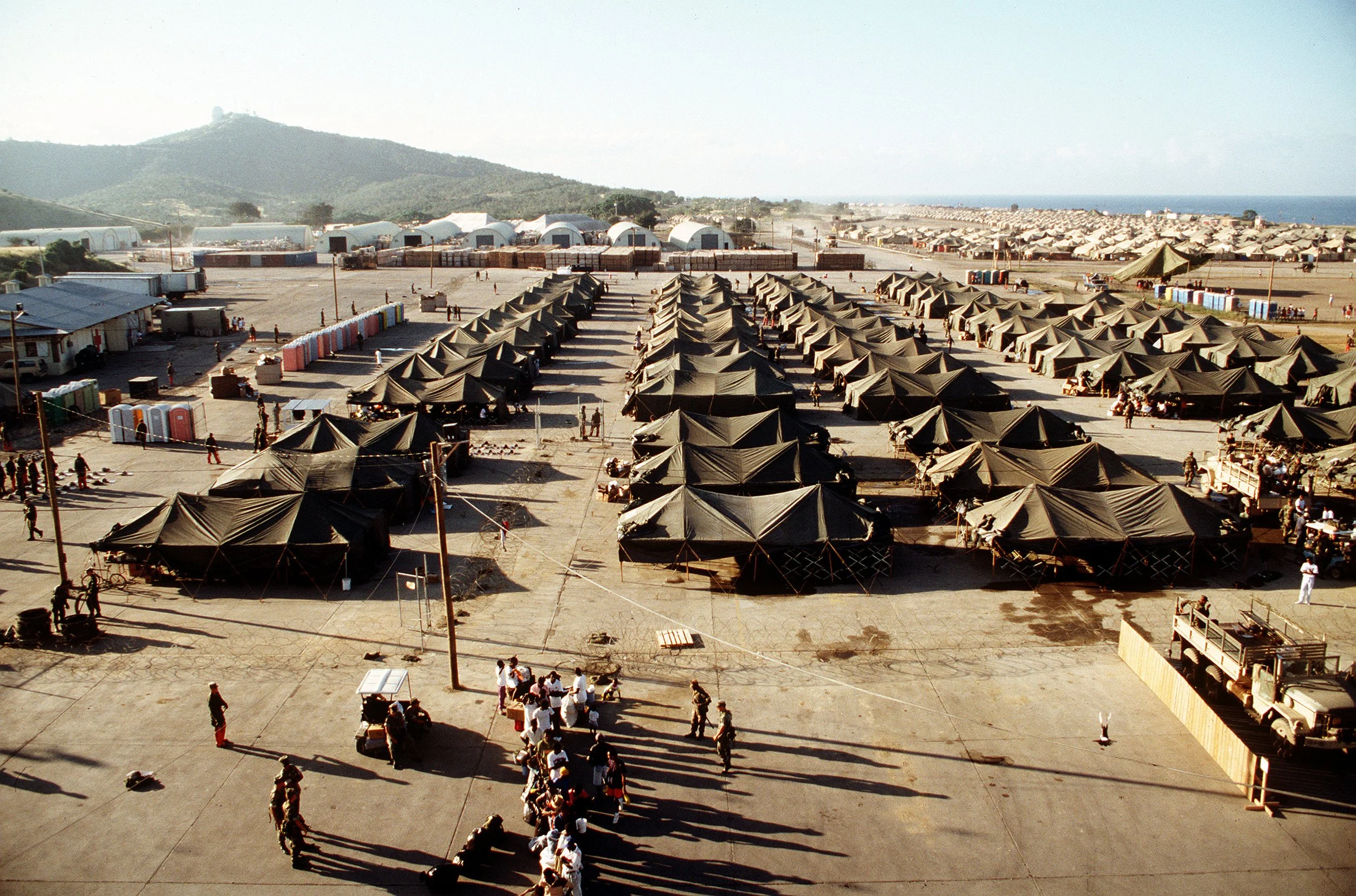
Despite the Clinton administration’s willingness to engage with foreign governments in this regard, only a handful of agreements were signed, and only rarely were camps actually built. Regardless, partners like Panama and the Turks and Caicos Islands received their “sweeteners.” In Suriname, for example, the U.S. military undertook Operation Distant Haven to create a camp for Haitians. Close to the international airport in Zanderji, U.S. military personnel and Surinamese employees raised living tents, constructed kitchen quarters, and created latrines. If the camp had come to fruition, Haitians, hoping to reach asylum in the United States, would have instead been transferred thousands of miles away from their destination. A joint military intervention into Haiti, however, restored Aristide to office and reduced the necessity of transferring Haitians from Guantánamo to the camp in northern Suriname. Nevertheless, the government of Suriname’s agreement with the United States stated that it would maintain possession of the infrastructural improvements and equipment used in the camp, and diplomatic officials considered how to properly organize the transfer of property from U.S. to Surinamese ownership.
The third country safe haven project was short-lived, and only rarely enacted, under the Clinton administration. However, the administration’s willingness to extend expansive economic and infrastructural aid packages to the governments of third countries demonstrates its commitment to excluding asylum seekers from the United States. Its actions moreover underscore that projects of migrant exclusion do not operate solely within national vacuums. This form of migrant exclusion is another component of foreign relations informing migration policy—and vice versa—thereby joining previous examples such as war-related refugee migration and deportations in support of national security. Though the Trump administration’s cooperation with the government of Rwanda is in its infancy, we should not doubt that there is historical precedent for the United States’ anti-asylee policies stretching into foreign countries. Indeed, as one journalist wrote in May 2025, the Trump administration is building a “global gulag,” a multi-continent array of countries willing to receive deported people from the United States, about which we should be extremely concerned.
Suggestions for Further Reading
Documents from the Clinton Digital Library and FOIA 2011-1045-F at the William J. Clinton Presidential Library
“Distant Haven,” Tropic Times, September 23, 1994, 8, https://dloc.com/UF00098947/00152/images/7, Digital Library of the Caribbean (dLOC), http://www.dloc.com, University of Florida.
“Suriname troops return,” Tropic Times, October 21, 1994, 1, https://dloc.com/UF00098947/00156/images/0, Digital Library of the Caribbean (dLOC), http://www.dloc.com, University of Florida.
Fitzgerald, David Scott. Refuge Beyond Reach: How Rich Democracies Repel Asylum Seekers. Oxford University Press, 2019.
García, María Cristina. The Refugee Challenge in Post-Cold War America. Oxford University Press, 2017.
Kahn, Jeffrey S. Islands of Sovereignty: Haitian Migration and the Borders of Empire. The University of Chicago Press, 2019.
Lindskoog, Carl. Detain and Punish: Haitian Refugees and the Rise of the World's Largest Immigration Detention System. University of Florida Press, 2018.
Loyd, Jenna M. and Alison Mountz. Boats, Borders, and Bases: Race, the Cold War, and the Rise of Migration Detention in the United States. University of California Press, 2018.
Mountz, Alison. The Death of Asylum: Hidden Geographies of the Enforcement Archipelago. University of Minnesota Press, 2020.
Paik, A. Naomi. Rightlessness: Testimony and Redress in U.S. Prison Camps since World War II. The University of North Carolina Press, 2016.
Tennis, Katherine. Outsourcing Control: The Politics of International Migration Cooperation. McGill-Queen’s University Press, 2020.
Walia, Harsha. Border and Rule: Global Migration, Capitalism, and the Rise of Racist Nationalism. Haymarket Books, 2021.
Material for this piece comes from Sarah R. Meiners, “Asylum Archipelago: Migration in the Borders of Empire in the Pacific and the Caribbean” PhD diss., Cornell University, 2025.