Mayday: histories of maritime rescue and repulsion

The internationally recognised radio distress signal, ‘Mayday’, came into the English language in 1923 in response to increased air and naval traffic over the Channel. Replacing the S.O.S call, Mayday, the phonetic pronunciation of M’aidez, French for ‘Help me’, is recognised by seafarers today. ‘Mayday’ captures the moral and legal duty of ships to rescue a person or persons in danger at sea. Such obligations are enshrined in the United Nations Convention of the Law of the Sea and the International Convention for the Safety of Life at Sea. Yet despite this duty and language of rescue, the response to the RNLI rescue operations in the Channel last week, namely the accusation that the Royal National Lifeboat Institution (RNLI) was in some way assisting people trafficking, reveals how this international obligation has been vilified by politicians and tabloids, as well as defended and upheld. The RNLI has entered the spotlight because of a change in the legal language of the UK government's new Nationality and Borders Bill: a minor change which is set to have major consequences for search and rescue operations in the Channel. In short, the phrase 'for gain' has been removed from the stipulation that a criminal offence occurs when a person 'knowingly (and for gain) facilitates the arrival or attempted arrival in, or the entry or attempted entry into, the United Kingdom' of a potential asylum seeker. This leaves organisations such as the RNLI, who save the lives of people in the Channel 'knowingly' but not 'for gain', vulnerable to charges of facilitating 'illegal' entry into the UK—a crime which is set to carry a maximum sentence of life imprisonment. In this post, I highlight four past blogposts which engage with the politics of maritime rescue and repulsion.

Exploring the foundations of Philippine refugee policy towards Vietnamese refugees

From the end of the Vietnam War in April 1975 through to the 1990s, hundreds of thousands of refugees fled from what had been Indochina. Their exodus triggered an international response. The Philippines, like other Southeast Asian states and Hong Kong, was a country of first asylum. Refugees were allowed to stay temporarily until resettlement elsewhere. Under the dictatorship of Ferdinand Marcos (1965-1986), the Philippine government laid the foundations of the country’s refugee policy: the extension of temporary asylum ‘on humanitarian grounds’. The Philippines at this time was not party to the UN 1951 Refugee Convention and its 1967 Protocol.

The political history of Uganda’s refugee policies

Uganda’s ‘self-reliance’ policy for refugees has been widely praised, and described by UNHCR as a model of development-based assistance for other countries to emulate: it allows refugees the right to work and freedom of movement. But while there is evidence to suggest that there are positive outcomes from the 'self-reliance' approach, rarely have these policies been examined in historical or political context. This post argues that ostensibly liberal policies have often emerged from illiberal politics.

Selective memory? How history figures in social sciences research on forced displacement to Germany

How is history mobilised in current social sciences research on responses to the large-scale refugee arrival in Germany since 2015? Some research seems to pay little or no attention to historical factors that might influence how newly arriving refugees are received by local residents. A second strand of research explores the dynamics of how specific communities of migrants who came to Germany in the past have responded to the arrival of Syrian and other refugees in 2015 and 2016. And a third strand of literature has started to analyse refugee reception through more local and contextualised case studies. In social science research, excluding past forced migrations from present understandings may contribute to reifying fixed boundaries—and that might prevent us imagining what a collective future could look like.

The dispersal of displaced persons in the British empire and beyond: from World War Two to the Partition of India

The multi-layered history of the people who lived in Valivade reveals a connected feature of British imperial and postcolonial policy: ‘dispersal’. Following the precedent of holding their prisoners of war at locations across their vast empire, as they had during the Boer War and World War One, the British transported World War Two internees and evacuees all over the empire, including to India. This policy was underpinned by the desire to block refugees and internees from entering the UK. India became a central prong of the strategy, as the British government decided to disperse and ‘hold’ diverse groups of refugees and prisoners of war in British India and in the Indian princely states—semi-autonomous regions subject to a form of indirect rule under their own sovereigns. The princely states became important sites of dispersal when the British leaned on them to accept World War Two evacuees. Very soon afterwards the new Indian government did the same, for partition refugees.

Themes in refugee history – call for papers

We are pleased to announce the second round of seminars in our series, Doing Refugee History, supported by the Institute for Historical Research and RefugeeHistory.org. This series of seminars will explore the subject of Themes in Refugee History and will run from October to December 2021.

The purpose of the seminar is to explore new ways of addressing established themes in refugee history (e.g. refugee agency) and to suggest innovative thematic approaches. Scholars at all career stages are encouraged to submit paper abstracts.

The historical connections of search and rescue at sea

Europe has recently witnessed an explosion of humanitarian efforts to assist stranded migrants in the Mediterranean and Aegean. The work of these search-and-rescue organisations was quickly propelled into the political limelight, and presented as a ‘pull factor’ encouraging migrant journeys. Rescue at sea has been swept up into a highly politicised crisis narrative one dominated by present-day anxieties surrounding ‘uncontrolled’ or ‘illegal’ migration. Aid workers at sea contest such an extraction of history by comparing their work to the past, referencing histories of migration and relief to dial down political rhetoric and legitimise their work. The historical experiences of seeking safety and of offering shelter have, as a result, become a central reference point for maritime rescuers.

Not just rescue: rethinking 30 April 1975 and Vietnamese diasporic history

In American imagination, the iconic image of a helicopter on a Saigon rooftop, with a long line of South Vietnamese desperate to escape, has often served as a visual shorthand for the end of the US war in Vietnam and the ensuing refugee ‘crisis’. But the fixation of Vietnamese refugees in 1975 needs to be revised. Most of the hundreds of thousands of Vietnamese who fled the country did so after 1975: displacement continued throughout the 1980s and 1990s. The question of whether they would be granted refugee status became more and more precarious over time, and Vietnamese were subjected to a controversial ‘screening’ process. But in camps and in the diaspora, there were countless examples of Vietnamese activism.

SWAPO’s struggle children and exile home-making: the story of Mawazo Nakadhilu

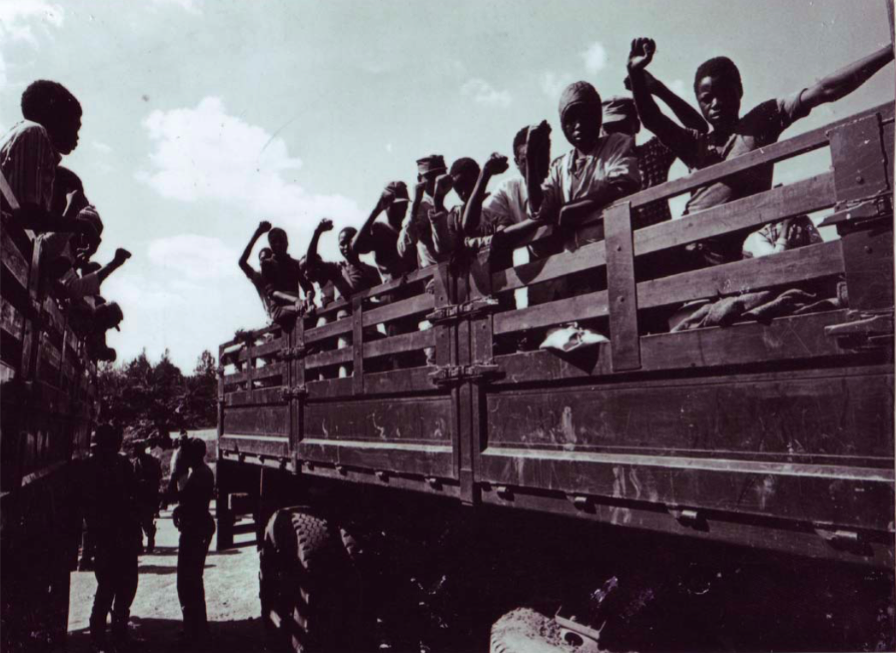
From the 1960s to 1990, the South West Africa People’s Organisation (SWAPO) opposed apartheid South African rule in Namibia, and administered camps for Namibian exiles in neighbouring countries. Mostly repatriated in time for Namibia’s political independence in 1990, many former exiles continue to appeal to the SWAPO-led government for assistance with their basic needs. Among them are ‘the children of the liberation struggle’, roughly ten thousand people born to at least one Namibian parent in exile. The struggle children emerged as a distinct group in 2008, presenting themselves to SWAPO as sons and daughters to whom the liberation movement and government bears an ongoing parental responsibility. This post tells the story of one of them, Mawazo Nakadhilu.