Returning Home as Refugees: Southeast Asian Huaqiao in the Second World War (1941-1945)
Upon the start of the Japanese conquest in Southeast Asia in December 1941, Louisa Chen Wei (No. 001351) left her teaching job in Taiping, a large mining town in the northern Malayan state of Perak. A frantic journey down the Malay Peninsula to Singapore soon followed. Huaqiao (Overseas Chinese) like Louisa had contributed resources and manpower to China’s war effort in the Second Sino-Japanese War (1937-1945). Louisa was also an ex-member of the Wuhan Choir which fundraised widely for China’s military and relief efforts. As a prime target for reprisal, she could feel the Japanese army following close behind as it marched down the Malay Peninsula.
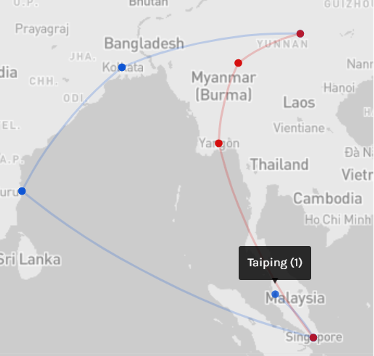
Louisa Chen's flight to China. Planned route in red, final route in blue. Map created in Palladio by author.
From Singapore, Louisa boarded a ship for Rangoon, Burma, aiming to head to Lashio at the Burmese-Chinese border. Japanese naval attacks forced her ship to dock in Madras. Louisa then relocated to Calcutta before flying to Kunming, China to weather the war with her family. She would eventually return to Malaya in 1947 as a teacher in Kuala Lumpur, before settling in Singapore by 1952.
Louisa’s “return” to China as a refugee huaqiao and later return to Malaysia was not unique. Her 1992 interview – held by the National Archives of Singapore Oral History Centre – forms part of the collection on the Japanese Occupation (1941-1945), yet counters narratives of Malayan-Singaporean huaqiao as static victims of the oncoming Japanese aggression. Testimonies from Louisa and other huaqiao discussing their experiences as refugees in China and their return to Southeast Asia, demonstrate how pre-existing diasporic linkages were entwined with concepts of ‘refuge’, ‘return’ and ‘repatriation’.
Huaqiao patterns of migration from the late 19th century to the mid-20th century were constructed around a circular movement between Mainland China and diasporic ‘destination’ with the eventual aim of returning home to their ancestral hometowns. However, many huaqiao eventually settled permanently in their new homes, raising families and laying down roots.
Though diasporic migration and labour-commercial relationships defined huaqiao mobility, the movements and circumstances of the Second World War huaqiao refugees who “returned” to China tie Chinese diasporic migration and refugee history together. While huaqiao saw the motherland, China, as a place of refuge and differentiation, they still sought to return to Southeast Asia under the emerging postwar refugee regime. Here I focus on the formation and return of Malayan huaqiao refugees in the Second World War and the early postwar period, paying attention to institutions that took an interest in their movements.
In the early years of the Second Sino-Japanese War (1939-1945), Southeast Asian huaqiao raised money for Chinese war and relief efforts, culminating in a unified Nanyang Federation of China Relief Fund(NFCRF). British Malayan colonial authorities regarded it warily as a source of possible Chinese violence. Japanese reprisal upon their expansion into Malaya was fierce, and fueled Louisa’s mad dash from Perak to Singapore.
Several other huaqiao managed to escape, following routes via India and Burma. These huaqiao refugees were generally well-connected and respected with sizable socio-cultural capital, who could easily afford to remit money beforehand, or had a wide support network. Tan Kok Kheng (No. 000232, Reels 41, 42), son of the huaqiao businessman-leader Tan Kah Kee, only managed to evacuate Singapore due to his own connections with the British colonial authorities and local elite in both British Malaya and China. Wealth and connections would also play a part in return, with Louisa’s own return to Malaya helped by having a teaching position arranged for her in Malaya.
An emotional assumption for huaqiao return made it easier for some to flee to China – Louisa saw it as a homecoming and remained in China after the war until 1947. But others had constructed the majority, if not all, of their lives in Malaya – refuge lacked the sense of ‘return’ for them. For example, Henry Lee Hau Shik - who would eventually become Malaya’s Finance Minister at its independence – had initially rejected the Wuhan Choir’s fundraising attempts for China, claiming that his homeland would be London instead of China. Yet, he would flee to China on the same ship as Louisa.
Within China, huaqiao were accorded the status of ‘returnees’, but were recognised as a unique group, unaccustomed to the local climes of the Mainland. Malayan huaqiao were unused to the Mainland’s weather and local diseases. Some lost family members. Others started businesses and poured resources into re-establishing connections with territories under Japanese Occupation – the Overseas Chinese Union Bank (No. 000057, Reel 11) being an example.
The Kuomintang (KMT) sought to exploit the ‘return’ of huaqiao refugees to its own advantage, diverting funds for their maintenance and inviting them to social events. Huaqiao refugees had tended to be political and business elites in their residential countries, which – until the arrival of the Japanese – had mostly been under European colonial domination. With optimistic views on an eventual victory, an expectation was present that these ‘returnees’ would eventually return to Southeast Asia upon war’s end, to facilitate widespread support and legitimacy for the KMT amongst huaqiao communities and the colonial states. Conversely, through proximity the KMT’s flaws and corruption became far more visible for their huaqiao supporters. Despite the KMT’s best efforts, it could not avoid losing huaqiao elite support, with some even switching sympathies to the Chinese Communist Party (CCP) as a result.
Upon war’s end in 1945, huaqiao sought to leave China en masse – UNRRA estimated their number at around 200,000. Some had made preparations as early as 1943, with the Kunming British consulate fielding queries from Malayan huaqiao on expiring paperwork. While the rich and well-connected could return nigh-immediately (such as Tan Kok Kheng who immediately flew back to Malaya to the bewilderment of his social circle), most huaqiao had to rely on NGOs such as UNRRA and CNRRA to facilitate their returns. UNRRA records in Feb 1947 reported at least 45,410 out of 200,000 huaqiao registered with UNRRA for repatriation. Several of these routes reversed the initial methods of flight, via the Burma Road or marine networks.
While the KMT state encouraged repatriation for political purposes, it also sought to restart the flow of huaqiao remittances from Southeast Asia to China for reconstruction. But being labelled as ‘returnees’ by the KMT could complicate huaqiao’s postwar attempts at returning to Southeast Asia. Postwar colonial states were reluctant to reabsorb the huaqiao refugees-turned-repatriates. While Malaya and Singapore both only required some proof of previous residence and sponsorship of family/prior connections, Burma was especially unwilling to even allow trial shipments, stating that native Burmans had filled in the vacuums left behind by fleeing huaqiao. Other obstacles involved huaqiao leadership clashes, and the embers of the Chinese Civil War, where suspicions of working with the other side could become reasons for detainment.
Huaqiao refugees who ‘returned’ to China thus represent an intersection of diaspora and refugee networks. With huaqiao taking on triple roles as ‘returnees’, ‘refugees’, and ‘repatriates’, they became a valuable population for both KMT and huaqiao communities as sources of political and economic weight. Beingamongst the first Asian refugees to be repatriated by UNRRA, the huaqiao refugee-repatriate cycle asks questions of how conceptions of ‘refugee’ and “repatriate” were formed in the postwar world order. The influence of not only international organizations, but also huaqiao 'patriate states' in Southeast Asia, whose reluctance to receive these 'repatriates' speaks to the complexity of national communities shaped by colonialism and diaspora.
Further Reading:
Akashi, Yoji, The Nanyang Chinese National Salvation Movement, 1937-1941, International Studies, East Asian Series (University of Kansas, Center for East Asian Studies, 1970), v.
Chen, Tina Mai, ‘Chinese Residents of Burma as Refugees, Evacuees, and Returnees: The Shared Racial Logic of Territorialization in the Regulation of Wartime Migration’, Modern Asian Studies, 49.2 (2015), 469–92
Leong, Stephen, ‘The Malayan Overseas Chinese and the Sino-Japanese War, 1937–1941’, Journal of Southeast Asian Studies, 10.2 (1979), 293–320
Oyen, Meredith, ‘The Right of Return: Chinese Displaced Persons and the International Refugee Organization, 1947–56’, Modern Asian Studies, 49.2 (2015), 546–71
Williams, Michael, Returning Home with Glory: Chinese Villagers around the Pacific, 1849-1949, (Hong Kong University Press, 2018)