The Palestinian Ghetto
It is now more than a year since the great Lebanese writer, Elias Khoury, died at the age of 76 after a long illness. Rightly tipped for the Nobel Prize for Literature, he died too soon. The author of fifteen widely translated novels, he was one of the most accomplished and innovative Arabic writers of his generation. Born in Lebanon, and a participant in the Lebanese Civil War (1975-1990), his focus changed gradually in the past three decades from Lebanon to Palestine. He foregrounded the continuous Nakba, which formed the subject of his last collection of essays. The Nakba (‘catastrophe’) refers to the Palestinians’ original dispossession and displacement in 1948; in common with many Palestinians, Khoury conceived of it as not a single event but an ongoing process (al-nakba al-mustamirra).
Khoury regarded literature as a form of testimony. His fiction is a way of remembering an erased Palestinian history in all its human complexity. After interviewing around a hundred Palestinian refugees in Lebanon, he incorporated many of their testimonies into his best-known 1998 novel Bab al-Shams (translated into English as Gate of the Sun in 2005) which was made into a film in 2004. Following Scheherazade in One Thousand and One Nights, the central character Khaleel attempts to revive Yunis, his surrogate father, from a coma by recounting circuitous stories of Yunis’s experiences of the Nakba, imprisonment and exile. Khaleel, the novel’s narrator and protagonist, acts as a doctor in an improvised hospital in Shatila, a Beirut refugee camp, and recounts the displacement of Palestinians since 1948. He also recognises Palestinians as the ‘second victims’ of the Holocaust after hearing about the experiences of Jewish refugees from Nazism in Palestine.
It was this empathy between two ‘communities of suffering,’ as Khoury’s friend Edward Said put it, that became the subject of his epic trilogy Awlad al-Ghetto from 2012-2023 (published in English as Children of the Ghetto, 2019-2024). I first came across Children of the Ghetto while writing a global history of the ghetto. My book showed that the history of the ghetto is part of a spectrum that separates racialized peoples but spans compulsory, segregated, and enclosedareas as well as more open enclaves. What intrigued me was the connection between Khoury’s trilogy and Israel Zangwill’s bestseller, the first novel in Britain peopled solely by an ethnic minority group. Zangwill’s novel was also called Children of the Ghetto (1898) which was about the East End ‘ghetto’ in London made up of Jewish refugees from the Russian pogroms. Khoury was aware that Zangwill was a dissident Zionist who followed Theodor Herzl, the founder of modern political Zionism, but Zangwill rejected Palestine as a Jewish homeland as it was already populated.
What is ironic about the word ghetto is that it refers to enclosed spaces but encompasses vast expanses of history. For Khoury, the forced and confined ghetto speaks equally to both Palestinian and Jewish history. The initial novel in Khoury’s Children of the Ghetto trilogy is subtitled Ismi Adam (2012) (My Name is Adam, 2019) after Adam Dannoun, the novel’s anti-hero named as the first child born in the Palestinian ‘ghetto’ in Lydda. Adam is adopted by neighbours after his father is killed and his young mother is unable to care for him. The epic series starts with the 1948 Lydda massacre, one of the worst atrocities of the Nakba, when Israeli forces killed more than 400 Palestinians in the city and forcibly expelled tens of thousands. Khoury’s narrator recounts that it was Israeli soldiers in 1948 who used the word ‘ghetto’ in relation to the barbed wire area that housed the remaining Palestinians in Lydda. The term was adapted to mean ‘the Palestinian quarter’ in other cities, such as Jaffa or Ashkelon, where a few thousand remaining Palestinians were also confined by the Israeli authorities to constricted spaces.
By the second novel in the series, subtitled Najmat-al-bahr (published in 2019 in Arabic and in 2024 in English as Star of the Sea), Dannoun is a teenager who runs away from his abusive stepfather in Haifa. He has, or so he thinks, ‘escaped’ the Lydda ghetto by working in a garage in Haifa and turning into the embodiment of the owner’s murdered brother in the Warsaw ghetto. Dannoun passes as Adam Danon, an Israeli Jew who, others presume, survived the Warsaw Ghetto. He learns Hebrew literature and travels to Warsaw to see the remnants of the ghetto and to meet a survivor of the Warsaw Ghetto Uprising. Khoury’s narrator wants to tell the story of the ghetto ‘in its entirety’ which is why Dannoun shifts identities from a New York-based Palestinian to a ‘48 Palestinian, to a Jewish Israeli, so that he can encompass the full meaning of the word ghetto. That is why the first volume concludes ‘because the ghetto remains, its stories have remained along with it.’
The ghetto that ‘remains’ is the Palestinian ghetto. This is made clear in the final volume of the series, entitledRajulon yushbihuni (2023) (A Man in My Image), which is set in 2002 in the West Bank refugee camps of Nablus and Jenin. In this novel Khoury goes back to the source of the testimonies in Gate of the Sun and reintroduces Khaleel. As he has often said, he does not write of the Palestinians but with the Palestinian people. This last volume has not yet been translated into English as Humphrey Davies, Khoury’s long-time collaborator and translator, died in 2021. We can only hope that Khoury’s English publishers can find a suitable translator for this final volume where we will learn of the multifaceted issues involved in narrating a traumatic history that is not yet over.
What makes Khoury such a unique novelist is that the subject of his fiction lives both inside and outside the pages of his books. Khoury recounts that one of his proudest moments came when a group of West Bank Palestinians in 2013 erected a camp near Jericho in a space that had been designated for an illegal settlement. They called their temporary home Bab al-Shams (Gate of the Sun) and spoke to Khoury about this gesture of solidarity. Fiction had become reality. The Palestinian ghetto in Lydda (Lyd in Arabic and Lod in Hebrew) is also remembered by a local Palestinian hip hop group DAM, who record in both Arabic and Hebrew and have influenced rappers in Jabalia, Ramallah, Khan Yunis and Jenin among other Palestinian towns and cities, while also having an international following. They describe their background as growing up in Palestinian ‘ghettos’ in Israel which is a feature of their songs. As with rap and hip hop in Soweto, DAM combine local culture with the influence of North American ghetto-centric gangsta rap.
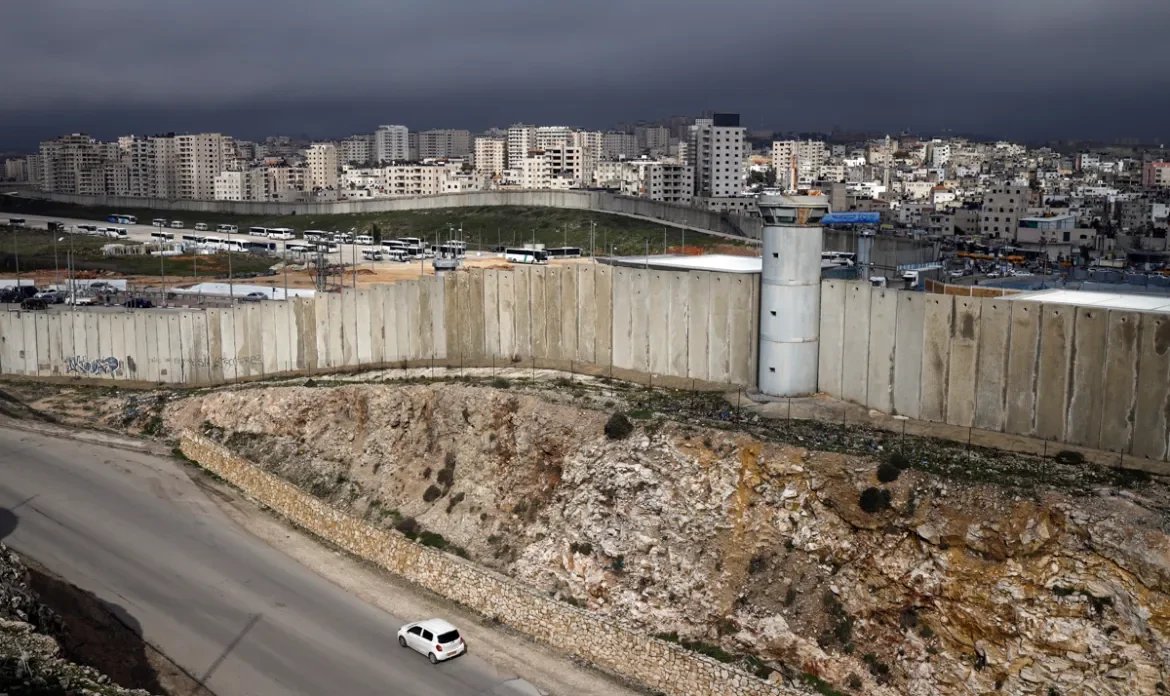
We have all witnessed Gaza as a ghetto. Indeed, one of the first documentary films about a Palestinian family living in Gaza’s Jabalia refugee camp was entitled Gaza Ghetto: Portrait of a Family, 1948–1984 (1985). In contrast with the more open Palestinian ‘ghettos’ in Israeli Jewish towns and cities, the Gaza ghetto is compulsory, enclosed and segregated. The separation wall surrounding much of the West Bank serves a similar function. Ghettos historically have been peopled by refugees or racialized minorities. Palestinian refugees or as a racialized people have followed this pattern and are similarly ghettoized in Gaza and the West Bank. An internet search for ‘Palestinian ghetto’ generates tens of thousands of results, with the phrase widely used in scholarly research on Palestine. But not many of us meet the challenge of Khoury’s fiction and essays and see the present and past history of the ghetto ‘in its entirety.’
In 2023, the Hannah Arendt Prize in Germany was postponed when award-winner Masha Gessen compared Gaza with the Nazi ghettos in a nuanced fashion. Gessen comes from a family of Holocaust victims and survivors, but this no longer mattered. Words can be cudgels used only to prolong the violence. Or they can be a means to connect suffering peoples. It is up to us how we use language. What we learn from Khoury is that the Palestinian ghetto can be a bridge to justice and mutual understanding even when it is a manifestation of dehumanization.