Prophetstown was a Sanctuary City, Part II
This is the second of a two-part series of posts reflecting on contemporary sanctuary practices and their precedents in Native North America. Click here to read Part I.
Though people travel to sanctuary spaces motivated by their fervent hope for collective survival, their efforts at securing safe harbor have been widely demonized. Fear of the power of the Ghost Dance propelled the US Army’s 1890 massacre of close to 300 Lakota encamped at Wounded Knee. (Secretary of Defense Pete Hegseth recently defended the medals of honor awarded to soldiers who murdered elders, women, and children at Wounded Knee.)
Similarly, notions of contemporary migrant caravans as hordes of rogues bent on the destruction of the United States animate the contemporary war on migrants and asylum seekers as well as the vilification of sanctuary practices. “Border czar” Tom Homan consistently refers to sanctuary cities as “sanctuaries for criminals,” demeaning the powerful history of these spaces.
While his brother gathered people to build their sanctuary city, Tecumseh traveled the Midwest and south, speaking to far-flung indigenous nations about the necessity of Indian people standing together in defense of their lands. He explained: “These lands are ours, and no one has the right to remove us. The Great Spirit above has appointed this place for us to light our fires.” Particularly after he accurately predicted the New Madrid earthquake of 1811, Tecumseh brought many more Indian people to commit to collaborating with the multinational alliance he envisioned, with many moving to join the new sanctuary community in Ohio.
Both Tecumseh and Tenskwatawa drew on indigenous prophetic traditions to mobilize broad resistance to deportation and dispossession. In the same way that Latin American liberation theology inspired many contemporary religious institutions in the 1980s to open their doors to asylum seekers from Central America, many of them indigenous, these leaders recognized the spiritual imperative to shelter and organize the dispossessed.
As food ran out in Ohio, Potawatomi shaman Main Poc encouraged Tenskwatawa to move the encampment west, into Potawatomi country. In 1808, Prophetstown, near contemporary Lafayette, Indiana, became the center for indigenous spiritual revival and political resistance in the Ohio River Valley. Indigenous people from around the Midwest and farther caravanned to the encampment, eventually numbering over three thousand there.
Towards Prophetstown, the land furrows into hills along the Wabash River. Historian Timothy Willig explains that local indigenous people had long viewed the confluence of the Wabash and Tippecanoe rivers near Prophetstown as a powerful spiritual site.
Strategically, these rivers provided access to the Illinois and the Great Lakes regions. And they provided drinking water, along with, perhaps, a sense of shelter and comfort for the thousands drawn to the encampment. In words that echo reports about maroon communities in the U.S. south, William Henry Harrison observed: “It is immediately at the center of that fine country which he [Tecumseh] wishes to prevent us from settling – and above all, he has immediately in his rear a country that has been but little explored…into which our cavalry could not penetrate, and our infantry, only by slow, laborious effort.”
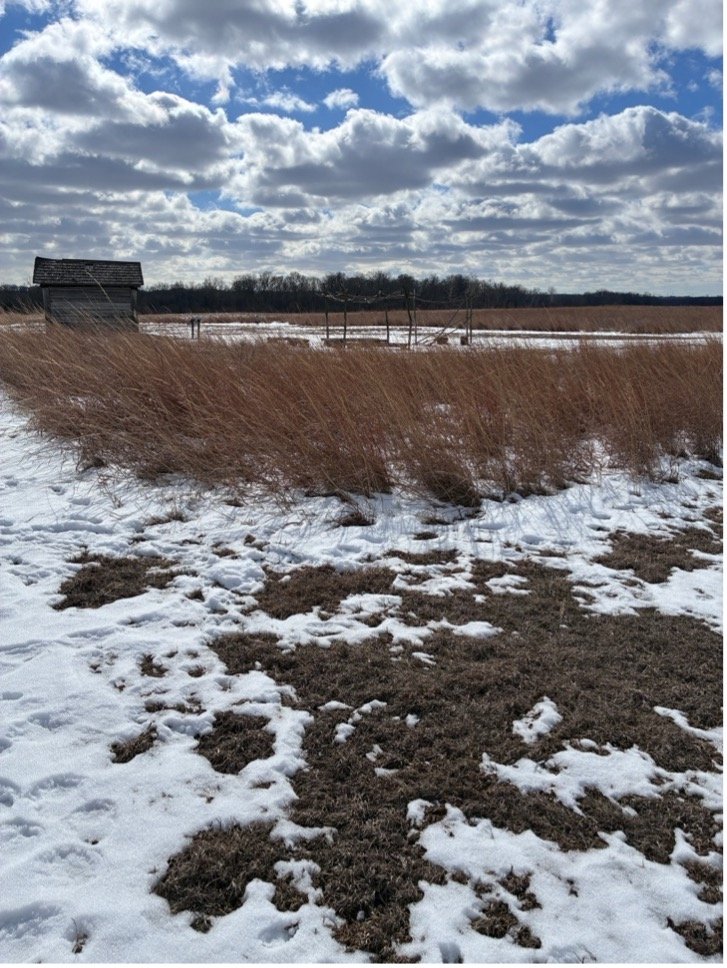
The state road wends its way through the moraine, eventually leading into the park. The entrance booth was closed, so I followed signs to the park headquarters, where the parking lot was choked with cars. Imagining the place crammed with grade school field trips, I made my way to the park building. I opened the door and found a small gift shop empty of people. Eventually, an un-uniformed woman carrying a baby emerged from a holiday gathering down the hall, cheerily took some cash for a couple of park stickers I wanted, gave me a brochure, and pointed the way to the “Indian Village” which represents a reconstruction of the Prophetstown encampment.
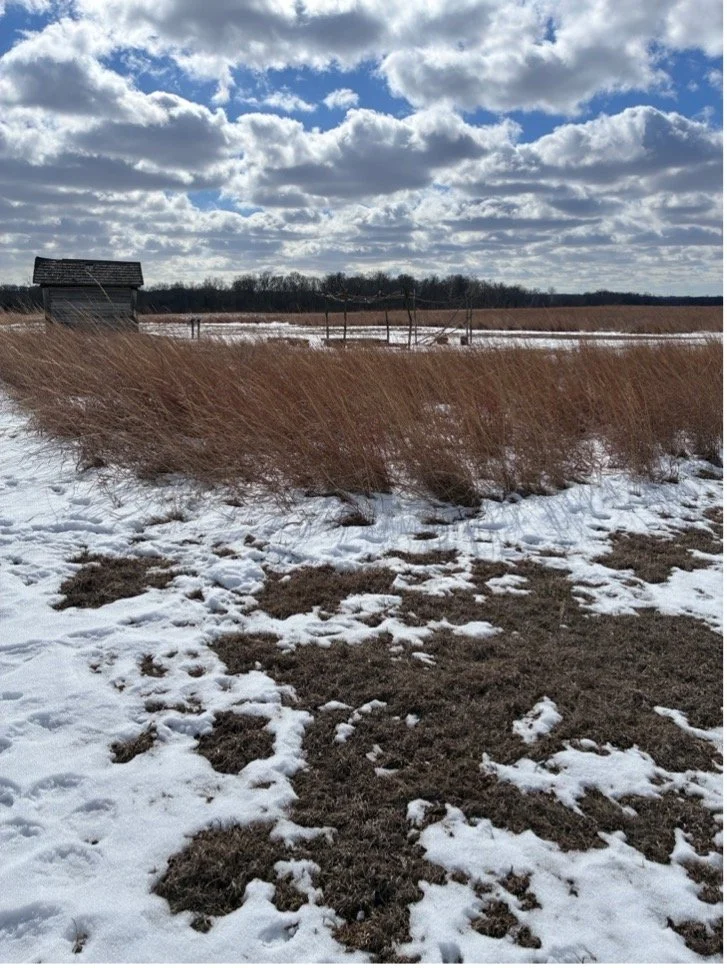
“Indian Village,” Prophetstown State Park. Photo taken by the author.
Researchers have not established the exact location of Prophetstown. The Indiana state park opened in 2004, featuring an “Indian Village,” situated near the visitor center. In 2013, in consultation with local Miami leaders, the Indiana State Park service rethought its approach. The park’s revised interpretive plan notes: “What is lacking is the emphasis on the sanctity of the site. The closest comparison is entering an active house of worship.”
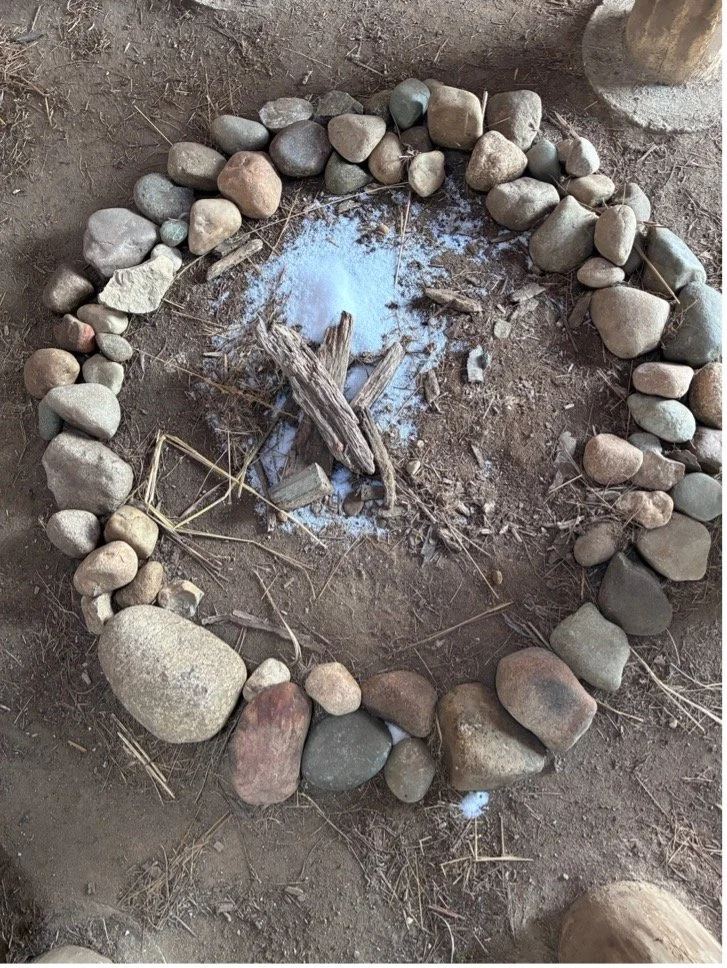
The current version of the “Indian Village” includes a “council house,” some dwellings typical of ones that denizens of Prophetstown might have built, and a “medicine lodge,” Inside the medicine lodge, there is a fire circle and herbs hanging to dry.
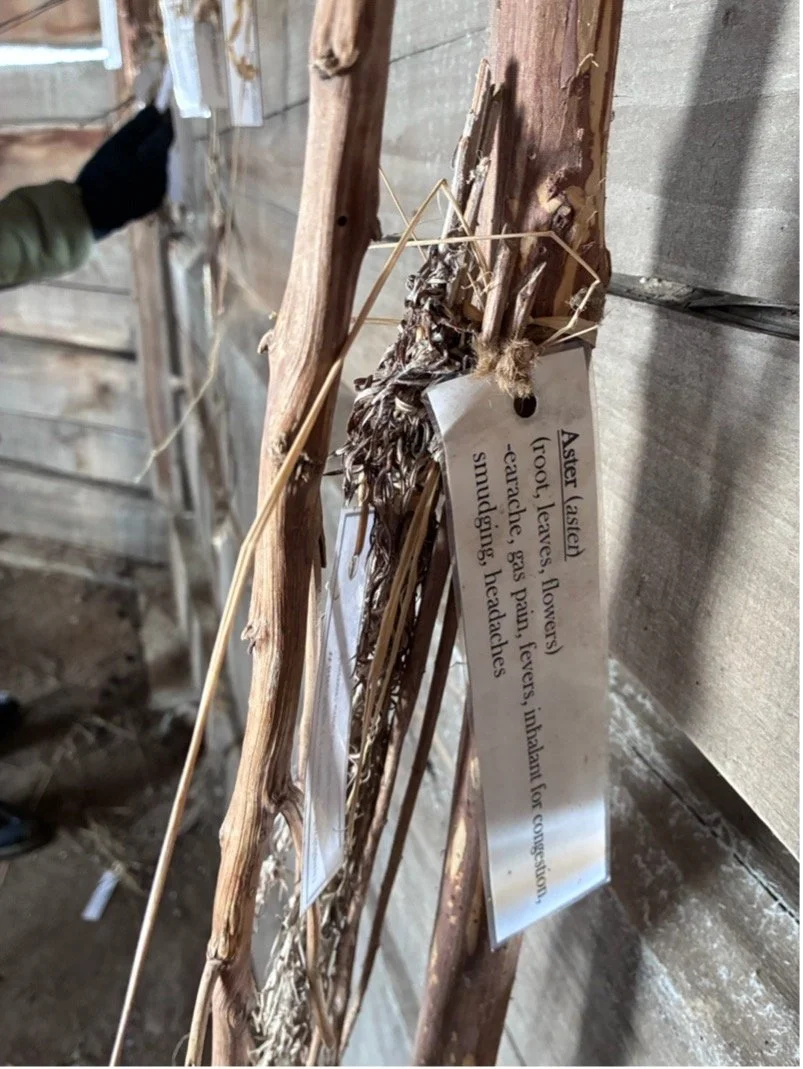
Labeled herbs, Prophetstown State Park. Photo taken by the author.
Sanctuary spaces like Prophetstown come into being at moments of grave peril, offering refuge and community care against state actions that displace people from their homes, separate families, and force difficult decisions about flight and relocation. Prophetstown was one of many sanctuary cities built throughout American history, to shelter people gathered in the hopes of defending their homelands and ways of life. There are many others, from early maroon communities, through the many indigenous spaces created out of solidarity and resistance, to cities like New York, Chicago, and Philadelphia which flouted runaway slave laws and sheltered African Americans in the long prelude to the Civil War.
In the contemporary period, community defense networks bolster sanctuary policies and create them where they are not in force. The pro-Palestine encampments on universities around the world were temporary sanctuary cities, built out of multiracial and interfaith solidarity, hosting conversations forbidden elsewhere.
The contemporary war against sanctuary cities takes place at a time of radical historical revisionism when state forces attempt to consign much of our collective history to oblivion. As it attempts to lay waste to sanctuary spaces, the current regime works to eradicate even their memory. Crusading for the wellbeing of a tiny percentage of wealthy people over the common good, this regime dreads the power and inevitability of collective resistance.
But the spiritual and political power of Prophetstown endures, blinking like a beacon off Interstate 65, broadcasting the news about its hidden history of collective resilience. Its message survived the burning of Prophetstown by Harrison as well as the forced relocations of many indigenous people from the Ohio Valley to “Indian Country” in Oklahoma; it weathered the Indiana state park service’s early framing of the place as an ahistorical “Indian village” until contemporary indigenous people gave voice to its ongoing power. Despite ongoing efforts to discredit and forestall sanctuary cities, they continue to represent powerful grassroots forces that resist and survive authoritarian brutality.
Works Referenced
Sylviane Diofe, Slavery’s Exiles:The Story of the American Maroons. NYU Press: New York, 2014.
Timothy D. Willig, Prophetstown on the Wabash: The Native Spiritual Defense of the Old Northwest , Michigan Historical Review, Vol. 23, No. 2 (Fall, 1997), pp. 115-158.