Caritas Kindertransporte: Catholic Relief, Mobility, and the Cold War
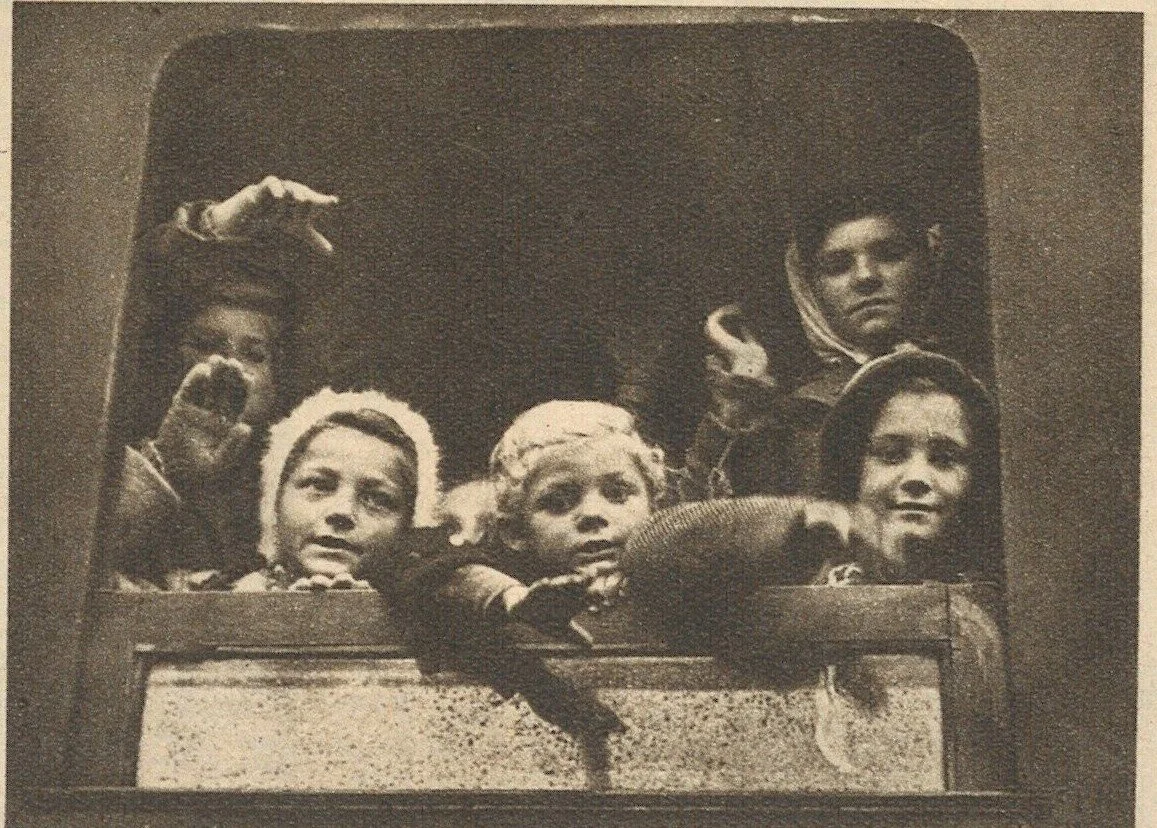
In October 1949, a train left the main station in Vienna with five hundred children on board. It headed towards the Spanish border city of Port-Bou, crossing northern Italy and France. Christine was one of the children that embarked on this very long journey. Earlier that year she had been diagnosed with tuberculosis and doctors informed her mother that a recovery period abroad in country with a milder climate was the only chance for her to survive the Austrian winter. Her mother then made the decision to enroll her in the Caritas Kindertransporte. Christine embarked on a journey of recovery and finally got off the train in Spain, where a foster family hosted her for six months. This experience was shared by thousands of children who spent time in Belgium, Holland, Switzerland, Spain, Portugal, and Luxemburg. Austrian children were supposed to find “refuge” in abroad families through the Catholic organization. While this approach differed radically from the post-war national and international focus of keeping families together, mobility management became part of an international effort—in the context of the early Cold War—to strengthen the children’s Catholic values.
Caritas Kindertransporte was one of the many humanitarian support actions carried out by Caritas in Austria. Caritas is a private Catholic organization active since the nineteenth century; it has organized social and religious activities in Europe, especially in the German speaking world. The enormous organizational effort undertaken by Caritas in support of refugees after the Second World War is often overlooked by general histories on humanitarian actions and refugee management. Religious humanitarian projects in post-war Europe provided assistance to refugees while championing Christian values as a bulwark against Communism. In the context of post-war reconstruction, both religious and non-religious organizations considered families and children as the fundamental element for European society’s “rehabilitation.” If the family was the holy unit of society, how come children were sent abroad, away from their families, for so long? This post explains how Catholic humanitarianism connected spiritual and physical rehabilitation through childhood relief actions.
Caritas Kindertransporte were part of a bigger humanitarian program that the organization carried out on behalf of civilians and refugees. The idea behind the Caritas Kindertransporte was that Austrian children would spend some months abroad to recover from the desperate post-war conditions in Austria. Contrary to the 1938/1939 Kindertransport of Jewish children to the United Kingdom, children taking part in Caritas Kindertransporte were supposed to only spend few months abroad. It was not easy for Caritas to support the idea that children were to be separated from their families. Children were sent to host families that had to resemble the unity of the family at home, but the issue persisted. Caritas pointed out that with the Kindertransporte program the organization was not meant to become a “travel agency” for children that “feel the need to travel”. The program represented a “necessity” to save children from the threat of the harsh Austrian winters. After the Second World War, the condition of Viennese children was anything but easy. Vitamins, fruit, and vegetables, as well as basic winter clothes were hardly available. Thus, between late 1945 and 1946, cases of tuberculosis constantly increased in the city.
Caritas activism in the humanitarian field played out in the context of post-war Austrian nation building. From 1939 and until 1945, Austria had been a part of the German Reich. While the country regained its independence at the end of the war, it was still a state in the making. It was only in the late 1940s that the final outline of some ministries and public offices was established. Moreover, Austria was occupied by Allied forces until 1955, when the State Treaty was signed. In this context, Caritas was one of the many organizations active in the humanitarian field. Austrian authorities aimed at coordinating public and private humanitarian actions so that they resonated with the early post-war national claims. For this reason, Austrian authorities established the In-und-Auslandshilfe (Domestic and Foreign Aid) to better coordinate the humanitarian efforts. Humanitarian aid and citizenship building went hand in hand, but Caritas did not give up its independence.
Caritas joined the In-und-Auslandshilfe but retained a degree of independence in various organizational aspects of the Caritas Kindertransporte. Destinations, participants, and logistics decisions belonged only to Caritas. The organization tried to achieve financial independence in terms of funding, too. Caritas financed the project mainly through self-funding initiatives, such as a prize lottery, but sometimes asked the Austrian state for help. For example, in 1947 Caritas issued a request to the public authorities to partially fund a recovery journey to Luxemburg. The idea was that families bore only little parts of the costs. Between 1947 and 1948, Caritas reported that the total amount spent on the Kindertransporte amounted to 2 million Schilling. In this context, fraudsters often took advantage of families’ wishes to support their children. In 1951, various newspapers reported that eighty-eight families in Vienna had been promised spots that never existed for Caritas Kindertransporte in exchange for large payments.
Caritas had a limited availability of places for the journeys abroad and often the Kindertransporte were fully booked. The organization selected children according to clearly established guidelines. Children underwent a medical examination, and parents had to fill in a form about their child, asking for details of religious behavior among other information. Guidelines could also be established by the host countries. Religion played a role in the selection process, but not only for the children. Host families were selected by local branches of Caritas through a form asking for details such as availability of medical services and the religious upbringing of the family members. In 1948, left-leaning Viennese newspapers broke the story that a child in poor health had been denied participation in the program because of insufficient attendance to the catechism classes. The matter reached the In-und-Auslandshilfe, and Caritas was asked to comment on it. The Catholic organization confirmed the version presented in the press and added that Caritas Austria had no say in the selection: the host country, Portugal, explicitly asked for “religiously educated children”.
Caritas considered Kindertransporte to be a chance for children to grow spiritually as well as physically. According to the organization, the experience was meant to strengthen children’s Catholic upbringing in a rapidly changing world. It would give children the chance to embrace the value of peace and reconciliation vis-à-vis materialistic and irreligious leftist values. These values, according to a shared interpretation among European Catholic newspapers, endangered the holy unity of the family by presenting the state as the main actor in children’s education and by pursuing solutions to social questions through class fight and conflict. The Catholic Church in Vienna presented itself as opposed to these violent extremes: social peace would have been eventually achieved, in the Catholic perspective, through charity and brotherly love.
Among other destinations, Spain was the host country that sparked most debate in Austria during the early post-war years. Spain had offered “recovery initiatives” to European children since October 1945. The idea behind childhood support actions was to re-shape the country’s international stance in the wake of the Second World War, with the support of the Catholic Church. Caritas Austria declined the first invitation issued by the Spanish authorities because of the risk of political infiltration. The organization was determined to keep the initiative of the Kindertransporte between Churches, carried out “from Caritas to Caritas”. At the same time, the political and social proximity of Spanish Catholic actors to Spanish state authorities vouched for a shared goal of international re-positioning through Catholic humanitarianism in the name of Catholic anti-communism.
Only in 1949, thanks to mediation by the Archbishops of Vienna and Madrid, was the collaboration between Caritas Austria and Caritas Spain launched. The first transport took place in February 1949, causing a stir in left-leaning newspapers in Vienna. Caritas was then accused of supporting Francisco Franco’s propaganda. Right-leaning newspapers rejected the accusations and claimed that the project had nothing to do with any political agenda, as the Catholic organization only supported the Church’s teaching through sacrament, pastoral care, and spiritual gifts. The debate surrounding the initiative confirms how childhood support practices held a double faceted value during the early Cold War. Children and their wellbeing became politically relevant to shaping future citizens in both the Western and Eastern camps.
The story of Caritas Kindertransporte is an example of how Catholic humanitarian championed moral and material aims at the same time. The program provided “refuge” to Austrian children in the harsh post-war conditions and, at the same time, it strengthened Christian and Western values in young citizens during the early Cold War period. While Caritas’ humanitarian efforts were part of the post-war European reconstruction, they represented a specific form of private projects that usually go undetected in the general histories of humanitarian actions. Religious humanitarianism pursued forms of citizenship-building that championed charity and brotherly love in opposition to class conflict and fostered the idea of Western society opposed to the Eastern bloc.
Further Readings:
Zahra, Tara, The Lost Children: Reconstructing Europe’s Families after World War II, Cambridge, Mass: Harvard University Press, 2011.
Mayr, Susanne, „Kinderverschickung nach Portugal. Erholungsaufenthalte in einer fremden Welt. 1947-1956“, historioPLUS, 1 (2014): 93-121.
Cortés-Braña, Lourdes, ‘Un asunto de Estado. La acogida de niños austriacos en la geopolítica del primer franquismo’, Ayer 129/1 (2023): 213-244.
Serina, Elena, ‘A Great Work of International Charity’: Catholic Humanitarianism, Displaced Persons and the Making of Post-War Europe (1945–1947), Contemporary European History (2025): 1-19.
Sources:
Archiv der Republik, 2608 Bundesministerium für Soziale Verwaltung, Vereine und Vereinigung, Die Caritas der Erzdiözese Wien, Berichtet über das Jahr 1947-1948.
Austrian National Library, Osterreichische Volksstimme, 5 February 1949.
Archiv der Sonntag, Der Fels, 2. Jahrgang, nr. 12, March 1949.