Over the past five years, tens of thousands of ‘ordinary people’ have undertaken voluntary work in support of, and in solidarity with, forced migrants in Europe. The New Internationalists: Activist Volunteers in the European Refugee Crisis, edited by Sue Clayton, aims to capture the scale and diversity of this international activist movement, lauded as one of the largest in European history. The book foregrounds the testimonial accounts of those volunteers who, with little to no training or support, worked to provide emergency aid, conduct sea rescues, develop community support structures, organise protests and advocacy campaigns and launch legal challenges with and on behalf of displaced people.
The French state skilfully navigates between staged scenes of camps spilling out of control and being brought back to order. Media visibility of camps circulates a message to the French public that immigration is excessive (and migrants are hungry, dirty, and sick)—and to migrants that they are not welcome. But if camps are too prominent they can become sites of solidarity. Camp evictions, meanwhile, are public relations exercises that follow a well-established script: emptying and destruction of the camp under the gaze of the media, promise that residents will be accommodated elsewhere; then (once the journalists have departed) ‘realization’ that the available accommodation is insufficient, followed by violent dispersal of remaining camp residents. This narrative disguises the state’s responsibility for the situation and reduces the horizon of migration policy to a single question: how to reduce numbers. It directs resources towards repression instead of integration.
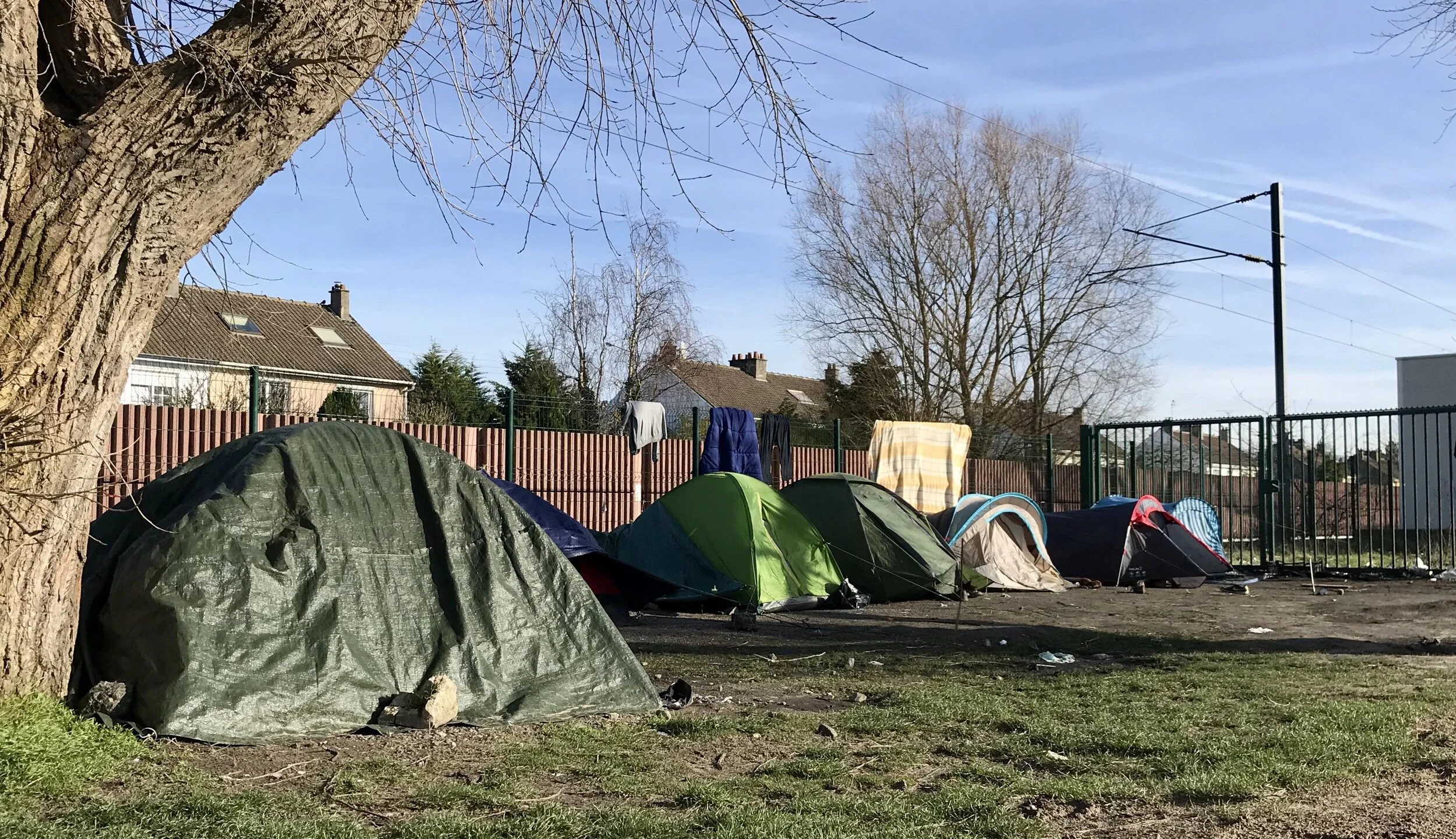
On Monday 23 November 2020, around 7pm, several hundred exilés pitched 200 tents on place de la République, Paris. The square was violently emptied by police that same night. This operation was far from unusual: since June 2015 there have been 66 such operations in and around the French capital. What does this latest episode reveal? That camps are a deliberate policy choice.
After the second world war, a Polish Resettlement Corps was raised as part of the British Army to allow Polish servicemen wishing to remain in the West to be demobilized and resettled to Britain. Some 125,000 chose to do this, the number growing to 200,000 when soldiers were joined by families who had spent the war in refugee camps in British colonies. The only way such a vast number of people could be accommodated in post-war Britain was by placing them in ex-army camps. Dozens across the country were turned into Polish resettlement camps, having been built in rural areas in the early 1940s for the American and Canadian troops. Blackshaw Moor in Staffordshire became one of them. This post discusses the memories of people who grew up there.
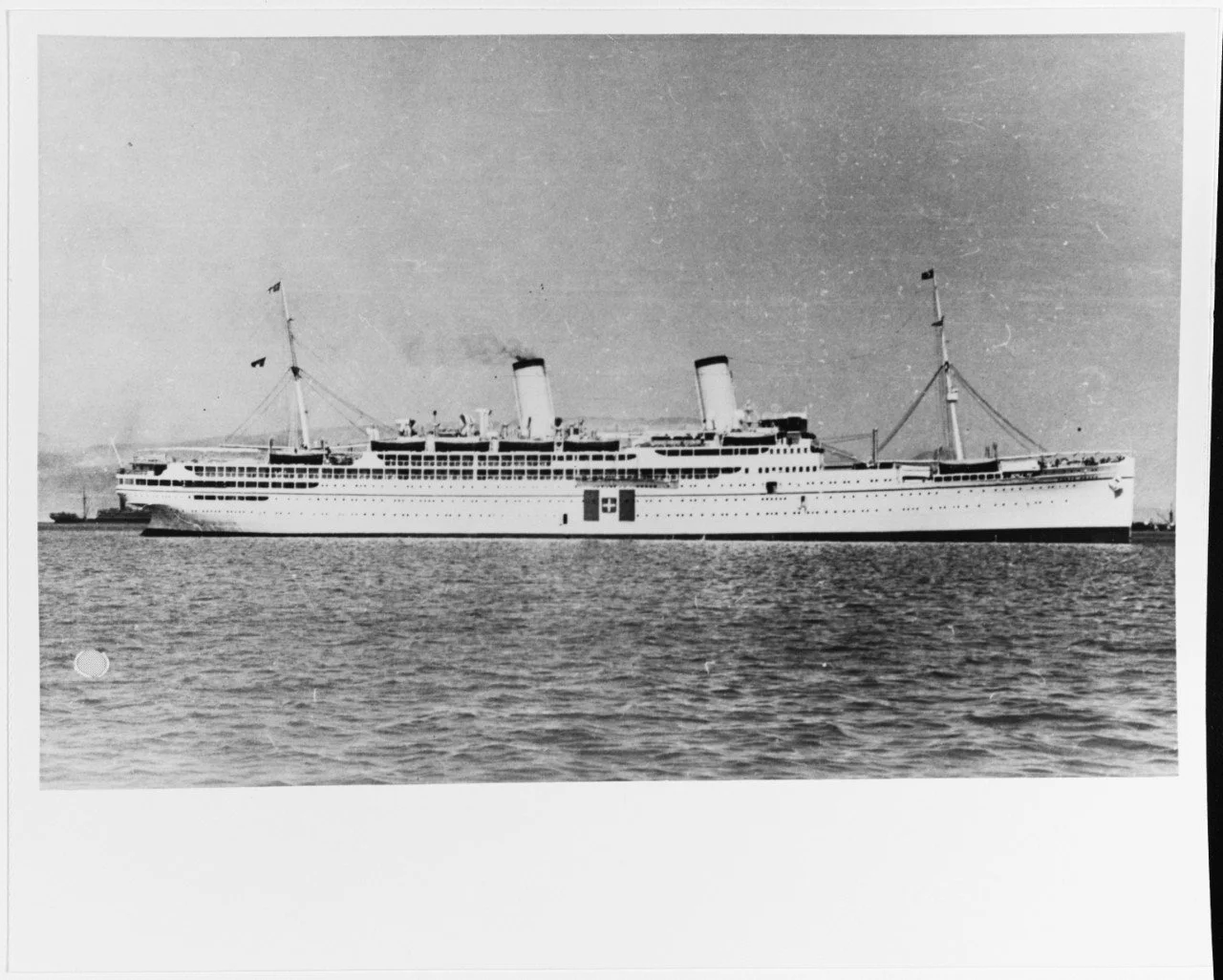
This post uses Helmut Newton’s provocative memoir, Autobiography, to explore how the ocean-going liner, as a mode of transportation, informed Jewish refugees’ experiences between 1938 and 1940. What did they do during their journey onboard Shanghai-bound ships? By joining Newton on the ship, this post draws connections between Holocaust Studies and Refugee Studies to reveal the significance of these vessels as a ‘space of possibilities’ for Jewish refugee passengers.
The act of deciding who deserves welcome in a country is determined not only by ‘hard’ legal facts such as visa or passport status but also by ‘soft’ factors coalescing around nebulous ideas of ‘belonging’. This post explores the experiences of Anglo-Egyptians in Britain, harkis in France, and retornados in Portugal to show just how complicated the politics of welcome and belonging could be, and highlights the role of ‘soft’ citizenship in the process.
There has been a recent global turn within Holocaust Studies: a growing body of scholarship focuses on Jewish refugees and the Holocaust in contexts that had been previously ignored, and highlights how those experiencing the war in Europe did so in different ways to those living through the conflict in other parts of the world. This post focuses on Jewish refugees who travelled to Japan, and who in the process often made journeys covering multiple countries across land and sea. For example, many Jews who arrived in Kobe, a city in Japan, in the early 1940s arrived via Poland, Lithuania, and the Soviet Union, having used the Trans-Siberian railway and sea travel to cross multiple borders.
Studies of neutrality tend to focus on legal and diplomatic aspects, but there is also an important social dimension: neutral territories are often destinations or stopovers for refugees, especially when these territories are adjacent to conflict zones. What does neutrality mean in practice when we put refugees at the centre of analysis? British-ruled Hong Kong and Portuguese-ruled Macau in the 1930s and 1940s offer connected case studies of displaced persons during the Second World War in East Asia.
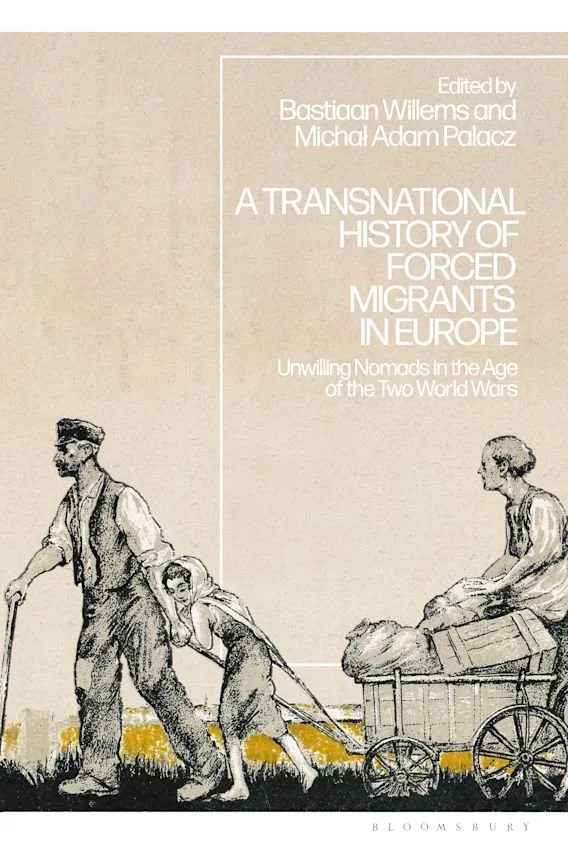
In the first half of the twentieth century millions of Europeans were displaced by war, genocide, the redrawing of international borders, and mass flight from countries ruled by autocratic regimes. In order to address the need for a more integrated analysis of their experiences, our edited volume A Transnational History of Forced Migrants in Europe. Unwilling Nomads in the Age of the Two World Wars looks at the collective experience of different refugee groups through the lens of a four-dimensional model of ‘host society’, ‘homeland’, ‘diaspora’ and ‘other diasporas’.
Casefiles are a common source for scholars in social history and related fields. They have, for instance, been crucial in the development of micro-historical approaches to the Holocaust. In recent years, they have been taken into consideration to examine humanitarian responses to and experiences of forced displacement. In this post, I would like briefly to discuss some of the potential, limitations, and challenges that this material entails. To do so, I will examine a specific set of sources: the casefiles of a group of more than 1,000 young Holocaust survivors who were resettled to Canada in the aftermath of the Second World War through a project sponsored by the Canadian Jewish Congress (CJC). These young people were predominantly Eastern European teenage boys who, at the time of application for a visa, lived in Displaced Persons (DP) camps, children’s homes and with foster families across Europe.
Relative to other forced migrants, refugees are in a privileged position in international law: they have legal status, rights under the 1951 Refugee Convention, and a specific organisation dedicated to their protection (UN High Commissioner for Refugees). Internally Displaced Persons, or IDPs, have a much less developed protection framework, even though the global population of IDPs is 59.1 million. So what explains this difference of treatment between these two categories of forced migrants?
The journeys of people who have been forced to leave their homes have, over centuries, included travel across water, including rivers, oceans, and seas. This post presents a new approach to researching refugee boat journeys by sea, based on a collaboration between historians and ocean engineers. We have used oral history research with survivors of a particular boat, rescued off Vietnam in June 1982, alongside numerical modelling so that the sea state the boat travelled through and the specific movement of the boat in those conditions could be determined. The scientific analysis explains how the ocean and weather, paradoxically, both created the conditions that were dangerous for this vessel, but also placed it in a position where it was rescued.
On 25 March 1997, the United Nations Refugee Agency (UNHCR) released its first global policy relating to urban refugees. Though UNHCR had always worked in towns and cities since its establishment in 1950, the agency itself viewed this work as peripheral to its main mission. By the 1980s and 90s the organisation had become firmly associated with large rural camps on the borders of states. A landmark piece of global refugee policy, the UNHCR Comprehensive Policy on Urban Refugees put down on paper for the first time a single, though contextual, approach to working in urban areas. But the March 1997 policy came under immediate criticism, and lasted less than nine months.
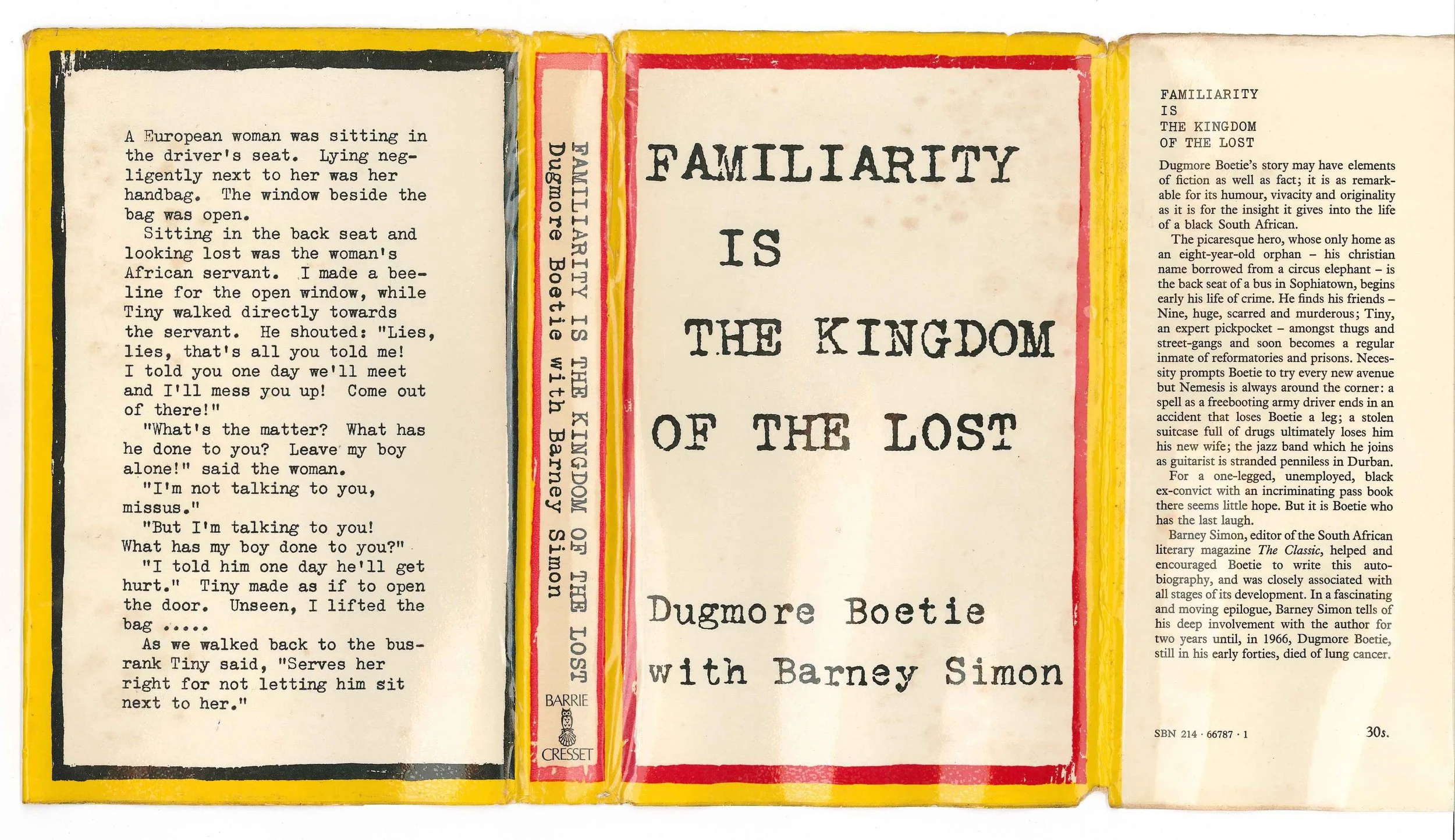
In August 1960, the Black writer and musician Dugmore Boetie fled apartheid South Africa and entered Bechuanaland (today Botswana) on foot. Boetie was one of thousands of refugees from apartheid. Unlike most, he returned soon afterwards—and his novel Familiarity is the Kingdom of the Lost is the only book describing apartheid by a Black writer residing in South Africa in this period.
In American imagination, the iconic image of a helicopter on a Saigon rooftop, with a long line of South Vietnamese desperate to escape, has often served as a visual shorthand for the end of the US war in Vietnam and the ensuing refugee ‘crisis’. But the fixation of Vietnamese refugees in 1975 needs to be revised. Most of the hundreds of thousands of Vietnamese who fled the country did so after 1975: displacement continued throughout the 1980s and 1990s. The question of whether they would be granted refugee status became more and more precarious over time, and Vietnamese were subjected to a controversial ‘screening’ process. But in camps and in the diaspora, there were countless examples of Vietnamese activism.
The French state skilfully navigates between staged scenes of camps spilling out of control and being brought back to order. Media visibility of camps circulates a message to the French public that immigration is excessive (and migrants are hungry, dirty, and sick)—and to migrants that they are not welcome. But if camps are too prominent they can become sites of solidarity. Camp evictions, meanwhile, are public relations exercises that follow a well-established script: emptying and destruction of the camp under the gaze of the media, promise that residents will be accommodated elsewhere; then (once the journalists have departed) ‘realization’ that the available accommodation is insufficient, followed by violent dispersal of remaining camp residents. This narrative disguises the state’s responsibility for the situation and reduces the horizon of migration policy to a single question: how to reduce numbers. It directs resources towards repression instead of integration.
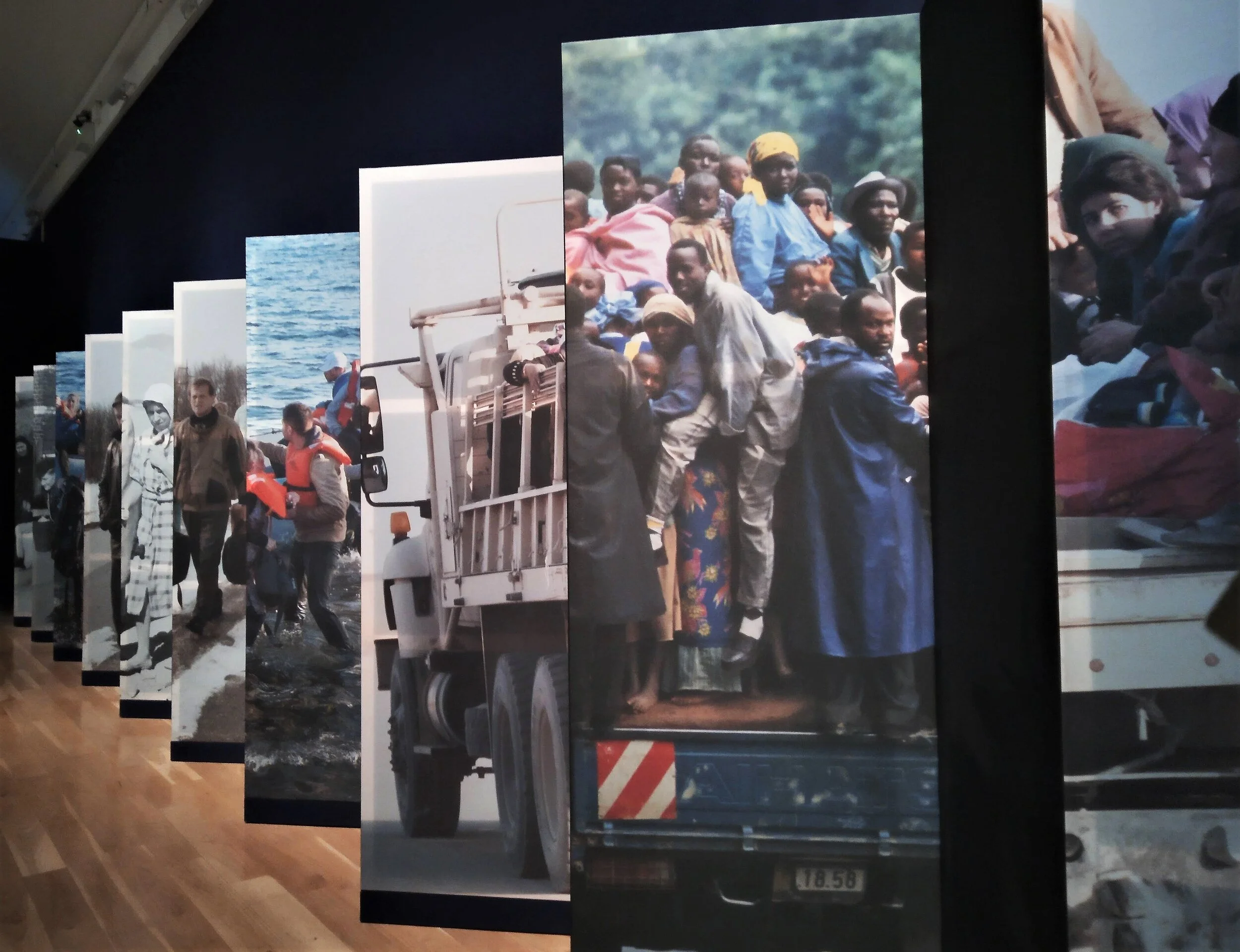
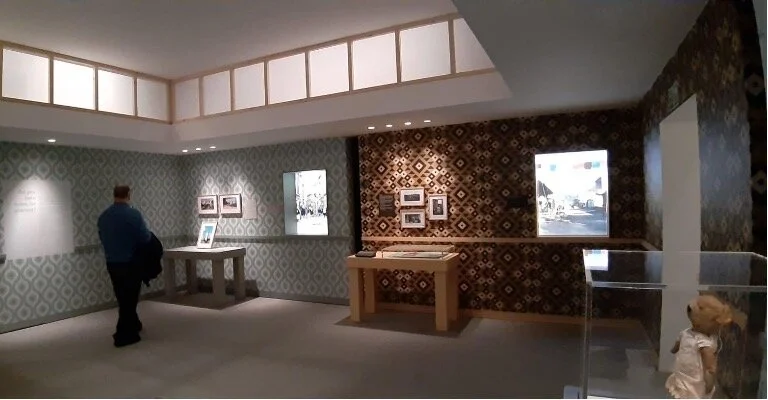
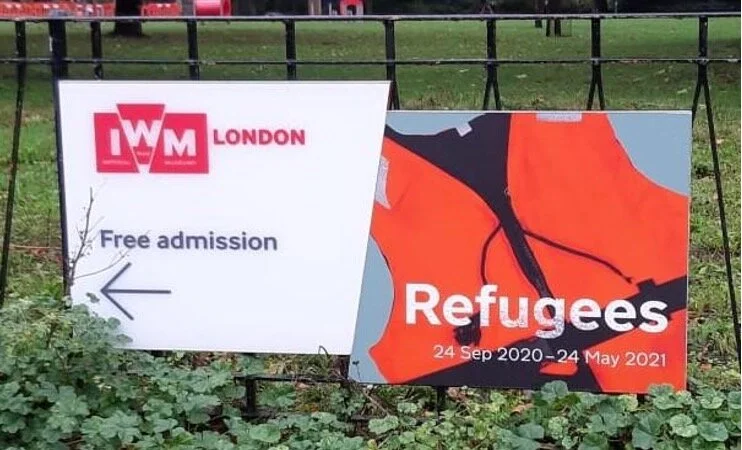
London Imperial War Museum’s Refugees season refutes modern-day crisis narratives about refugees. It historicises displacement to address global refugee movements across the past century, striking a tough balance between providing a space for refugees to tell their own stories and presenting academic research.
Forced to Flee is an expansive exhibition covering a range of angles, from the triggers for displacement, the journey that refugees have made, crossing borders, refugee camps, and reception in the UK. The exhibition looks at historical situations as well as recent displacement, and some clear themes emerge. The strongest is an emphasis on the human, the personal experience. Another is the diversity of community responses to refugees arriving in the UK. The third is the focus on conflict as a cause of displacement—though this means other causes are neglected. Overall the exhibition is ambitious and timely.
The exhibition includes refugees from a wide range of contexts. All looked similar to me: they had all lived in camps, fled their own country, and suffered on the journey to arrive at a safe place. The exhibition makes you wonder about how they lived. There are things that give an incomplete impression, but overall it is a really nice exhibition.
There is nothing shocking, dramatic or distressing about Forced to Flee. It avoids representing any of the physical effects of forced displacement on the human body: anguish, injury, illness, destitution, death – or crying. The exhibition not only challenges the idea of the refugee as a silent suffering body, but interrupts the whole set of emotional relationships that go along with that idea. Forced to Flee spans a century of refugee history, but rather than taking each historical moment in turn, the exhibition follows the steps of a ‘typical’ refugee story: the departure, the journey, the arrival, the asylum procedure, the integration process.
This week we run a virtual round table about the Imperial War Museum’s Refugees season, especially the exhibition Forced to Flee. Drawing together the perspectives of researchers, practitioners, and those with lived experience of displacement, it seeks to engage with and reflect upon the scope and aims of the exhibition, its historical remit and comparisons, its artistic and curatorial choices, and its specific exhibits.
In our second post commemorating the 1947 Partition of India, writer and critic Sandeep Parmar offers a powerful, personal and critical reflection on the workings of refugee memory. We are used to thinking about how later generations host the memories of the traumas suffered by earlier generations but, Parmar asks, 'in the case of Partition, how does the postmemory generation speak of the trauma of silence, not memory, of a postforgetting?
In The Refugee System, Rawan Arar and David Scott Fitzgerald offer an avenue for overcoming the limits of the siloed approaches which direct research on refugees. Situating their work at the intersection of international migration, forced displacement, and conflict studies, they propose a ‘systems approach’ which ‘shows how “refugeedom” – the relationship between refugees, state, and society – interacts with refugeehood – the experience of becoming and being a refugee.’ Their findings attest that work on refugeedom is immeasurably strengthened by understanding how displaced persons themselves may view this matrix as they navigate its confines.
In her book Refugees in Twentieth Century Britain, Becky Taylor carefully explores the reception, experiences and significance of refugees in Britain across the twentieth century. Time and time again, she demonstrates how closely bound up the refugees’ lives have been with the British public’s own experiences of changing political and social factors, whether these two groups come face to face or not, and however much of a gulf the media may lead people to believe exists between ‘us’ and ‘them’. Making sense of a huge range and diversity of sources, the book beautifully demonstrates the complexities and contradictions of British society, and the many ways refugees encountered these complexities.
As Refugee Week 2021 coincided with Refugee History's five-year anniversary, we have taken the opportunity to curate and republish a selection of pieces from our growing archive. These articles were chosen for two reasons: first, they tackle important issues in the field of refugee history, and second, they reflect many of the values and priorities of the Refugee History project.
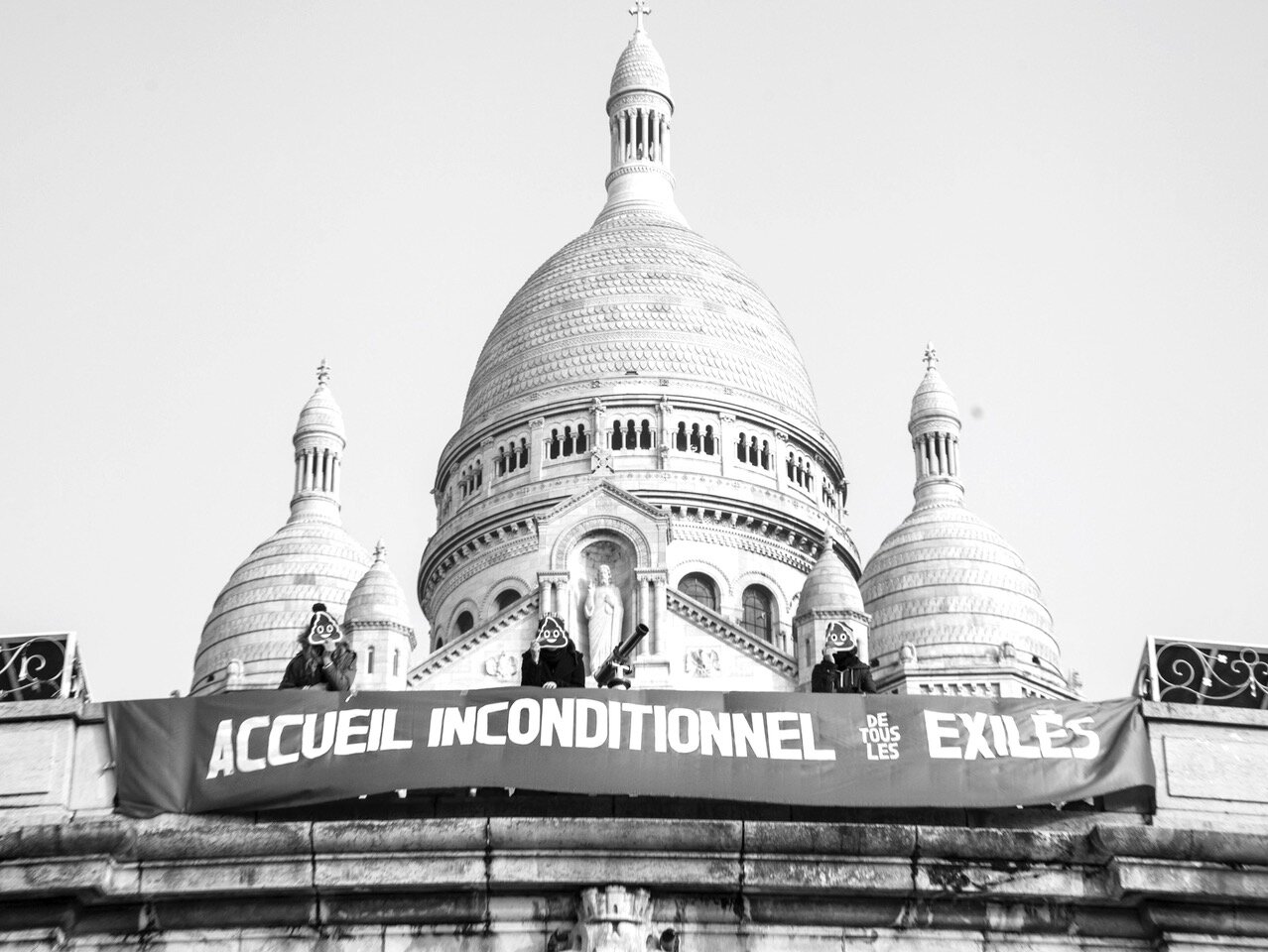
Over the past five years, tens of thousands of ‘ordinary people’ have undertaken voluntary work in support of, and in solidarity with, forced migrants in Europe. The New Internationalists: Activist Volunteers in the European Refugee Crisis, edited by Sue Clayton, aims to capture the scale and diversity of this international activist movement, lauded as one of the largest in European history. The book foregrounds the testimonial accounts of those volunteers who, with little to no training or support, worked to provide emergency aid, conduct sea rescues, develop community support structures, organise protests and advocacy campaigns and launch legal challenges with and on behalf of displaced people.
London Imperial War Museum’s Refugees season refutes modern-day crisis narratives about refugees. It historicises displacement to address global refugee movements across the past century, striking a tough balance between providing a space for refugees to tell their own stories and presenting academic research.
Forced to Flee is an expansive exhibition covering a range of angles, from the triggers for displacement, the journey that refugees have made, crossing borders, refugee camps, and reception in the UK. The exhibition looks at historical situations as well as recent displacement, and some clear themes emerge. The strongest is an emphasis on the human, the personal experience. Another is the diversity of community responses to refugees arriving in the UK. The third is the focus on conflict as a cause of displacement—though this means other causes are neglected. Overall the exhibition is ambitious and timely.
The exhibition includes refugees from a wide range of contexts. All looked similar to me: they had all lived in camps, fled their own country, and suffered on the journey to arrive at a safe place. The exhibition makes you wonder about how they lived. There are things that give an incomplete impression, but overall it is a really nice exhibition.
There is nothing shocking, dramatic or distressing about Forced to Flee. It avoids representing any of the physical effects of forced displacement on the human body: anguish, injury, illness, destitution, death – or crying. The exhibition not only challenges the idea of the refugee as a silent suffering body, but interrupts the whole set of emotional relationships that go along with that idea. Forced to Flee spans a century of refugee history, but rather than taking each historical moment in turn, the exhibition follows the steps of a ‘typical’ refugee story: the departure, the journey, the arrival, the asylum procedure, the integration process.
This week we run a virtual round table about the Imperial War Museum’s Refugees season, especially the exhibition Forced to Flee. Drawing together the perspectives of researchers, practitioners, and those with lived experience of displacement, it seeks to engage with and reflect upon the scope and aims of the exhibition, its historical remit and comparisons, its artistic and curatorial choices, and its specific exhibits.
On 27 November 2021, twenty-seven lives were abandoned to the English Channel by the French and British states, as fifteen calls in distress went unanswered. A year later, Le Monde exposed the exchanges between those on board the small boat and the regional maritime rescue and surveillance centre in the Pas-de-Calais, exchanges which the French state initially denied had taken place. ‘Tu seras pas sauvé… je t’ai pas demandé de partir’, rang the voice of one operator to the call of distress at sea: ‘You will not be saved… I did not ask you to leave [France]’.
This loss of life at sea, while the worst incident in thirty years in the Channel, in fact fits within a historical continuity of the last twenty years of violent and reactive Franco-British border politics. In this history, the agency of those who have decided to make this perilous journey is deeply constrained: what does choice look like when there is simply ‘no other option’?
It is impossible to think about refugees, write about refugees, advocate on behalf of refugees or provide refugees with practical support without the use of statistics. And yet scholars and practitioners working on the refugee issue were surprisingly slow to examine the complexities associated with the collection, analysis and dissemination of quantitative data. As I pointed out in a paper published in 1999, “while all of the standard works on refugees are replete with numbers, few even begin to question the source or accuracy of those statistics.” The issue of refugee and displacement statistics is now taken a great deal more seriously than was the case two decades ago. Even so, the issue of displacement data remains problematic.
Refugees living in camps are often not perceived as historians for ‘historically explicable reasons’, to borrow Bonnie Smith’s phrase. They do not do the things historians do because they cannot: they cannot consult archives, they cannot access university libraries (or, often, libraries at all), they cannot depend on reliable internet and computer access, let alone the funding, research support, training, social networks, and material resources that underpin the research and writing of academic history. It is as though encamped refugee and historian have been defined as mutually exclusive identities. A person residing in a refugee camp cannot be a historian because a historian, quite simply, cannot be a person residing in a refugee camp.
What if we were to disrupt this tautology? To redefine what being a historian means?
Kenya has received more than half a million refugees since 1991. However, except for two instances of group resettlement, very few refugees received resettlement opportunities. During the last decade, for instance, only 37,522 people have been officially resettled, despite many more arriving. Kakuma camp, however, has become known as a ‘resettlement hub’ and, as I show in this post, the lives of residents are affected by such perceptions. I discuss how refugees move from the hope of surviving to a new, dream-like lifestyle which the term “hopehood” encapsulates. In doing so, I argue that though hope has served as an instrument to enable people to endure prolonged encampment in an enclosed place, unrealistic hope has separated residents from reality, so that chasing a rare chance of resettlement becomes itself a mode of life.
As we enter the 2021-22 academic year, we are considering ways in which Refugee History can respond usefully to what has been a summer peppered with sensationalist media headlines about refugee movement.
With this in mind, we are calling for submissions for autumn 2021 on the theme of criminality and criminalisation, for which we have identified two main branches: the criminalisation of asylum seeking, and the criminalisation of non-state actors assisting people seeking asylum.
The internationally recognised radio distress signal, ‘Mayday’, came into the English language in 1923 in response to increased air and naval traffic over the Channel. Replacing the S.O.S call, Mayday, the phonetic pronunciation of M’aidez, French for ‘Help me’, is recognised by seafarers today. ‘Mayday’ captures the moral and legal duty of ships to rescue a person or persons in danger at sea. Such obligations are enshrined in the United Nations Convention of the Law of the Sea and the International Convention for the Safety of Life at Sea. Yet despite this duty and language of rescue, the response to the RNLI rescue operations in the Channel last week, namely the accusation that the Royal National Lifeboat Institution (RNLI) was in some way assisting people trafficking, reveals how this international obligation has been vilified by politicians and tabloids, as well as defended and upheld. The RNLI has entered the spotlight because of a change in the legal language of the UK government's new Nationality and Borders Bill: a minor change which is set to have major consequences for search and rescue operations in the Channel. In short, the phrase 'for gain' has been removed from the stipulation that a criminal offence occurs when a person 'knowingly (and for gain) facilitates the arrival or attempted arrival in, or the entry or attempted entry into, the United Kingdom' of a potential asylum seeker. This leaves organisations such as the RNLI, who save the lives of people in the Channel 'knowingly' but not 'for gain', vulnerable to charges of facilitating 'illegal' entry into the UK—a crime which is set to carry a maximum sentence of life imprisonment. In this post, I highlight four past blogposts which engage with the politics of maritime rescue and repulsion.
How is history mobilised in current social sciences research on responses to the large-scale refugee arrival in Germany since 2015? Some research seems to pay little or no attention to historical factors that might influence how newly arriving refugees are received by local residents. A second strand of research explores the dynamics of how specific communities of migrants who came to Germany in the past have responded to the arrival of Syrian and other refugees in 2015 and 2016. And a third strand of literature has started to analyse refugee reception through more local and contextualised case studies. In social science research, excluding past forced migrations from present understandings may contribute to reifying fixed boundaries—and that might prevent us imagining what a collective future could look like.
Europe has recently witnessed an explosion of humanitarian efforts to assist stranded migrants in the Mediterranean and Aegean. The work of these search-and-rescue organisations was quickly propelled into the political limelight, and presented as a ‘pull factor’ encouraging migrant journeys. Rescue at sea has been swept up into a highly politicised crisis narrative one dominated by present-day anxieties surrounding ‘uncontrolled’ or ‘illegal’ migration. Aid workers at sea contest such an extraction of history by comparing their work to the past, referencing histories of migration and relief to dial down political rhetoric and legitimise their work. The historical experiences of seeking safety and of offering shelter have, as a result, become a central reference point for maritime rescuers.
In 2010, a Nigerian woman living in the UK sought refugee status on the ground that her abusive husband had publicly and vociferously labeled her a witch. Since the early 2000s, increasing numbers of African asylum seekers coming from across the continent to the global north have made witchcraft-based asylum claims. They argue that being accused of witchcraft renders them ‘members of a particular social group’ (PSG) and thus eligible for refugee protection under the 1951 UN Refugee Convention. Cases like Uwaifo provide a fruitful terrain to consider how cultural understandings or misunderstandings complicate the process of determining who counts as a refugee.
On Monday 23 November 2020, around 7pm, several hundred exilés pitched 200 tents on place de la République, Paris. The square was violently emptied by police that same night. This operation was far from unusual: since June 2015 there have been 66 such operations in and around the French capital. What does this latest episode reveal? That camps are a deliberate policy choice.
We’ve just added a research guide to refugee settlement and encampment in the Middle East and North Africa from the 1860s to the 1940s to our Resources page. Produced by our contributor Baher Ibrahim, it’s a four-page PDF that gives an overview of archives and resources for researchers interested in this subject, especially those available online (it contains many links and pointers).
As Refugee Week 2021 coincided with Refugee History's five-year anniversary, we have taken the opportunity to curate and republish a selection of pieces from our growing archive. These articles were chosen for two reasons: first, they tackle important issues in the field of refugee history, and second, they reflect many of the values and priorities of the Refugee History project.
How can archives document, preserve and make accessible the material culture and first-hand testimonies of modern migration?